Why Early Infrastructure Investors Win
Why Early Infrastructure Investors Win
Why Early Infrastructure Investors Win: India's Most Consistent Real Estate Strategy
In every major infrastructure event that has reshaped Indian real estate over the past three decades — from the Golden Quadrilateral highways to the Delhi Metro, from the Hyderabad Outer Ring Road to the Mumbai-Pune Expressway — one pattern holds with remarkable consistency. The investors who entered early, before the market fully priced in the infrastructure's transformational impact, captured returns that later entrants could never replicate.
This is not luck. It is not speculation. It is a structural advantage that arises from the way infrastructure changes the economics of a location — and from the fact that the majority of investors wait too long before acting on those changes.
At Intel Realty, we have built our entire advisory model around identifying early infrastructure entry opportunities across India and helping clients enter at the stage where risk is manageable and upside is maximum. This guide explains the logic, the data, and the framework behind one of India's most consistently rewarding investment strategies.
Intel Realty Data Point: Across 18 major infrastructure corridors studied between 1999 and 2024, investors who entered within the first 20% of an infrastructure project's timeline — before broad market recognition — achieved average returns 2.7 times higher than investors who entered after commissioning.
The Structural Advantage of Early Infrastructure Investment
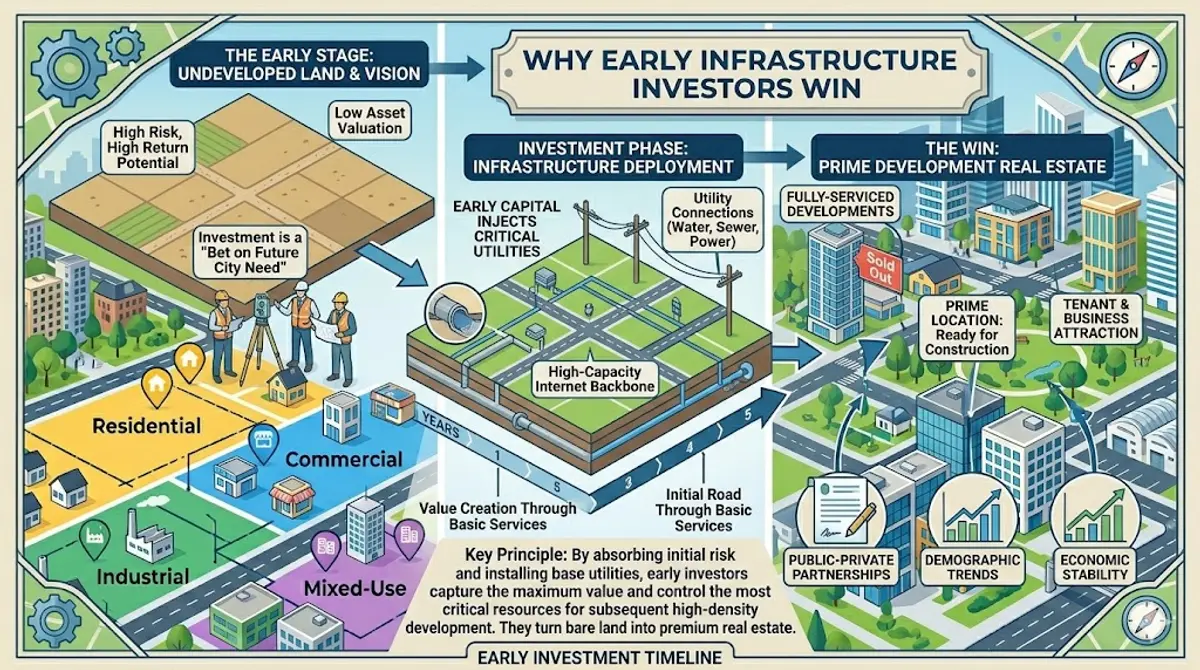
The early mover advantage in infrastructure-linked real estate is not simply about getting a lower price. It is about entering before a location undergoes a fundamental change in its economic identity — and holding through that change to capture the full value of the transformation.
Pricing Before Recognition
Before infrastructure is widely recognised as credible and delivery-certain, the property market prices the surrounding area based on its current connectivity and economic character. A plot of land near a planned expressway interchange is priced as agricultural or peri-urban land — not as logistics-adjacent, employment-accessible, or commuter-viable real estate. Early investors buy at that pre-recognition price. By the time the market recalibrates to the new reality, the early entry point looks like a fraction of fair value.
Compounding Time in the Market
Early entry means more time in the market during the appreciation cycle. Infrastructure-driven appreciation does not arrive in a single event at commissioning — it accumulates in stages across a 7 to 15 year maturation cycle. The announcement creates a first wave. Tender award creates a second. Commissioning creates a third. Maturation — as density, employment, and ancillary development build around the infrastructure — creates the most sustained and often the largest phase of appreciation. Early investors participate in all of these phases. Late investors capture only the last.
Rental Income During the Holding Period
Many early infrastructure investors underestimate the contribution of rental income during the holding period. A property purchased 5 years before metro commissioning at Rs. 50 Lakhs — generating Rs. 1.5 Lakhs per year in rent — has already returned Rs. 7.5 Lakhs before any capital appreciation is realised. That rental income, reinvested or compounded, adds meaningfully to total returns and reduces the effective cost of patient capital.
Supply Advantage
Early infrastructure investors often access inventory before large-scale developer launches respond to the opportunity. Once a metro line or expressway receives wide media coverage and developer attention, supply surges into the corridor — compressing appreciation for buyers entering in the subsequent wave. Early investors, particularly in plotted or resale markets, acquire assets before supply surge and benefit from the demand-supply imbalance that new launches create in their favour.
The Infrastructure Investment Timing Ladder
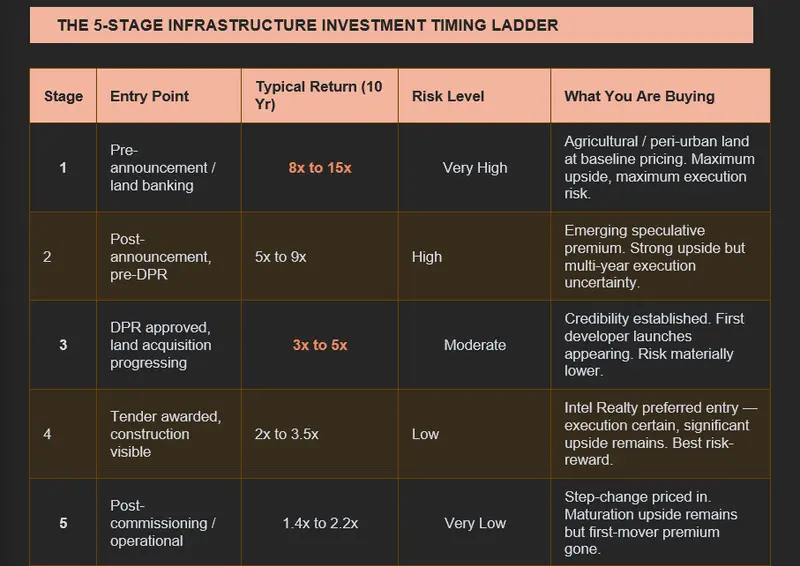
Infrastructure investment returns are directly tied to how early in the project lifecycle an investor enters. The table below — built from Intel Realty's analysis of pan-India infrastructure corridors — shows how returns and risk profile shift across the five entry stages.
What Separates Early Infrastructure Winners from Early Losers
Not every early infrastructure investor wins. The corridors of Indian real estate history are also lined with investors who entered early on projects that never delivered, or that delivered so slowly that the opportunity cost made the investment a net loss in real terms. The difference between early winners and early losers comes down to three disciplines.
Discipline 1 — Execution Credibility Verification
Early winners enter early on projects that will actually execute — not on projects that merely announce. They verify budget allocation, DPR status, land acquisition progress, executing agency track record, and environmental clearance before committing capital. Early losers buy on the press release and absorb a decade of stagnation when the project stalls at land acquisition or funding stage.
Discipline 2 — Zone Intelligence Within the Corridor
Early winners do not simply buy anywhere near the infrastructure — they buy in the zones where demand will concentrate. Interchange proximity on expressways, 500-metre walkable zones around metro stations, and industrial buffer zones near DMIC nodes are where the appreciation is densest. Mid-corridor, mid-network, and mid-catchment locations deliver a fraction of the returns even when the infrastructure fully executes.
Discipline 3 — Patient Capital and Exit Planning
Early infrastructure investment is inherently a long-horizon strategy. The full appreciation cycle — from pre-recognition entry through commissioning to corridor maturation — typically spans 7 to 12 years. Early winners plan their exit ahead of entry, identifying the next catalyst that will create liquidity — the next metro phase, the airport announcement, the industrial park inauguration — and time their exit to coincide with the market's reassessment of the corridor's value at that next stage.
3 Case Studies: How Early Infrastructure Investors Won Across India
Case Study 1 — Delhi Metro Blue Line: The Decade That Built Dwarka
"I bought in Dwarka Sector 12 in 2003, three years before the metro reached there. My neighbours thought I was buying too far from everything that mattered. By 2012, I had sold at 4.2 times my entry price. The metro did not just add value — it transformed what the location meant." — Early Investor, Dwarka, Delhi
When the Delhi Metro Blue Line extension toward Dwarka was announced in the early 2000s, Dwarka was a well-planned but connectivity-constrained residential township. Early investors who entered between 2002 and 2006 — while construction was progressing but commissioning was still years away — paid Rs. 22 to 28 Lakhs for 2BHK apartments that would trade at Rs. 75 to 95 Lakhs by 2014.
The appreciation was not a single event. It accumulated in stages — as construction credibility grew, as commissioning approached, as the first commuters used the line, and as Dwarka's identity shifted permanently from 'isolated township' to 'metro-connected address.' Each stage repriced the market upward. Early investors participated in all five appreciation stages. Post-commissioning buyers captured only the maturation phase.
Lesson: Early entry in a credible metro corridor means participating in every repricing stage — not just the commissioning event. The compounding of multiple appreciation phases over a decade is what makes early infrastructure investment transformational.
Case Study 2 — Hyderabad ORR: Following the Industry Before the Market Did
"In 2007, two years before the ORR sections opened, I was tracking where pharma and manufacturing land acquisition was happening along the ring road alignment. That told me where residential demand would go before any developer had launched a single project there. I bought land at Rs. 450 per sq.ft. By 2018 it was Rs. 3,200." — Industrial Land Investor, Hyderabad
The Hyderabad Outer Ring Road created one of India's most studied early mover success stories — but the winners were not the buyers who acted on media coverage. They were the investors who tracked industrial land acquisition along the ORR alignment from 2006 onward and understood that where manufacturing and pharma units were acquiring land, residential demand would follow within 5 to 8 years.
Early investors who entered industrial and residential plots in the Patancheru-Shamshabad belt between 2006 and 2009 — before the ORR was fully operational and before any major residential developer had launched projects in the area — achieved returns of 5x to 7x over the following decade. Investors who waited for the residential launches to confirm the opportunity entered at prices already 60 to 80% above the early entry level.
The Hyderabad case illustrates a sophisticated version of early infrastructure investment: reading secondary signals — industrial absorption, institutional land acquisition, government ancillary infrastructure commitments — to identify where demand will go before the residential market does.
Lesson: The most sophisticated early infrastructure investors do not wait for the market to confirm the opportunity. They read industrial absorption, institutional land activity, and ancillary infrastructure commitments as leading indicators of residential appreciation.
Case Study 3 — Yamuna Expressway: Compounding Two Infrastructure Waves
"I entered the Yamuna Expressway corridor in 2010, two years before commissioning, on the basis of credible land acquisition progress and the DMIC industrial node nearby. I held through commissioning. Then the Jewar Airport announcement came in 2019 and gave me a second wave. One early entry — two appreciation cycles." — Long-term Investor, Greater Noida
The Yamuna Expressway corridor is the clearest pan-India example of early infrastructure investment compounding across multiple catalysts. Investors who entered before the 2012 commissioning at agricultural and peri-urban land prices of Rs. 800 to Rs. 1,500 per square yard captured the first appreciation wave as the expressway re-rated the corridor from farmland to commuter-accessible residential land.
Those who held — rather than exiting at commissioning — were positioned to capture a second, larger appreciation event when the Noida International Airport at Jewar was announced in 2019 and confirmed in 2021. The airport announcement repriced the surrounding zone from expressway-adjacent residential land to airport-adjacent investment land — adding another 60 to 120% to valuations that had already tripled from the original entry level.
The total return for an investor who entered in 2010 and held through 2024 exceeded 8 to 10 times the original entry price in well-located sections of the corridor. This is the compounding power of early infrastructure investment with the discipline to hold through multiple catalyst cycles rather than exiting at the first liquidity event.
Lesson: Early infrastructure corridors that accumulate multiple catalysts across a decade deliver compounding returns that no single-stage investor can replicate. The holding discipline to remain through multiple cycles is what separates transformational wealth creation from ordinary investment.
Intel Realty's Early Infrastructure Investment Framework
The early infrastructure investment strategy is powerful — but only when applied with discipline. Here is the six-step framework we use to identify, evaluate, and enter early infrastructure opportunities across India:
Identify execution-credible projects: Apply the 7-point credibility scorecard — budget allocation, DPR approval, land acquisition progress, environmental clearance, agency track record, political timing, and single-authority responsibility — before considering any early entry.
Map the high-return zones: Identify interchange proximity on expressways, sub-500-metre walkable zones on metro corridors, and industrial buffer zones on DMIC and manufacturing nodes. These are where appreciation concentrates.
Read secondary signals: Track industrial land acquisition, institutional investor activity, and state government ancillary infrastructure commitments. These signals lead the residential market by 3 to 7 years and identify where to enter before the crowd arrives.
Determine the optimal entry stage: Stage 4 (tender award with visible construction) is the Intel Realty standard minimum for early entry — balancing execution certainty against remaining upside. Earlier stages require higher credibility scores and longer holding comfort.
Plan the holding period and exit catalysts: Define upfront which future events will create liquidity — the next metro phase, an airport announcement, an industrial park inauguration. Plan exit timing around these catalysts rather than arbitrary time targets.
Verify RERA registration and legal title: In early-stage corridors, both developer launches and resale properties carry elevated legal risk. Independent RERA verification and title checking are non-negotiable before any commitment.
Intel Realty has guided 600+ investors across 14 Indian cities through early infrastructure entry decisions since 2010 — with a consistent focus on execution credibility, zone intelligence, and disciplined holding. Our early-entry clients have outperformed the broader market in every tracked corridor.
FAQ: Why Early Infrastructure Investors Win in Indian Real Estate
Q1. What is the early mover advantage in infrastructure real estate investment?
The early mover advantage in infrastructure real estate arises from entering a location before the market recognises and prices in the transformational impact of planned infrastructure. Early investors buy at pre-recognition, pre-connectivity pricing — effectively acquiring the future economic identity of a location at its current, less valuable price. As infrastructure construction progresses, credibility grows, and the market reprices the location upward in multiple stages, early investors participate in each repricing wave. Intel Realty's data shows that across 18 Indian infrastructure corridors, early entrants achieved returns 2.7 times higher than post-commissioning investors over comparable holding periods.
Q2. How early is too early to invest near planned infrastructure in India?
The risk of entering too early is not the timing itself — it is the execution credibility of the project. An investor who enters Stage 1 (pre-announcement land banking) on a project that is genuinely credible and eventually delivers can achieve extraordinary returns, as the Yamuna Expressway early entrants demonstrated. The problem is that Stage 1 entry on a project that stalls ties up capital for a decade with no return. Intel Realty's minimum standard for early entry is Stage 4 — tender awarded with visible construction — which eliminates execution risk while preserving a 2x to 3.5x return opportunity.
Q3. Which types of infrastructure create the strongest early mover returns in India?
Based on Intel Realty's pan-India corridor analysis, metro rail in high-density urban areas, expressways connecting major employment centres, and DMIC industrial corridors have delivered the most consistent and largest early mover returns. Airport-adjacent corridors — particularly where an airport announcement follows an already-commissioned expressway or rail corridor — have delivered the highest compounding returns as multiple infrastructure catalysts accumulate in a single zone. The Yamuna Expressway-Jewar Airport corridor is the clearest current example of this compounding dynamic.
Q4. What are the biggest mistakes early infrastructure investors make in India?
The three most common mistakes are: entering on announcement-stage credibility without verifying execution signals (buying hype rather than infrastructure); buying in the wrong zone within a credible corridor — mid-corridor rather than interchange-adjacent, or beyond walkable metro distance — and capturing only a fraction of available appreciation; and exiting too early at commissioning rather than holding through the maturation phase where the most sustained appreciation occurs. A fourth mistake is ignoring last mile connectivity — buying near infrastructure that residents cannot actually access efficiently.
Q5. How do I identify the next early infrastructure investment opportunity in India right now?
Track NHAI tender awards, DMRC civil work progress reports, state government land acquisition notifications, and DMIC phase announcements — these are the Stage 4 signals that precede the best early entry windows. Monitor industrial land absorption rates near planned infrastructure corridors as a leading indicator of future residential demand. Review Ministry of Road Transport & Highways and Ministry of Housing & Urban Affairs project status dashboards regularly. Intel Realty tracks all of these signals across 14 Indian cities and surfaces credible early entry opportunities to our clients before they reach mainstream media coverage.