The Gurugram Land Grab: Why Developers Bet ₹8,500 Cr
The Land Grab: Why Tier-1 Developers Spent ₹8,500 Cr on Gurugram Plots in One Year
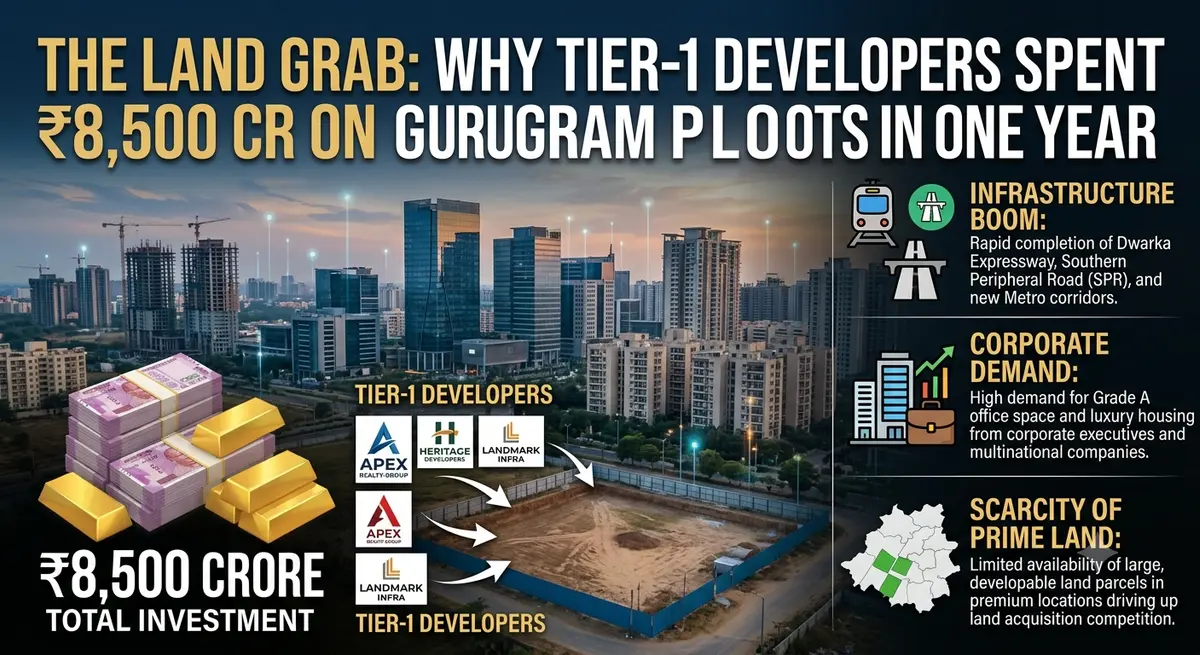
Gurugram's land market has turned into the most watched battleground in Indian real estate. Over the past twelve to eighteen months, a wave of listed and institutional developers — Prestige Estates, Godrej Properties, M3M Group, Signature Global, and L&T Realty among them — have collectively committed well over ₹8,500 crore to acquiring land parcels across the city's key corridors.
This isn't scattered opportunism. It's a coordinated bet that Gurugram's next growth cycle will be won by whoever controls land today. This article breaks down who's buying, where, how much, and — more importantly — what it signals for homebuyers and investors watching from the sidelines.
Why Land, and Why Now
Three forces are driving this rush simultaneously.
First, infrastructure has finally caught up with ambition. The Dwarka Expressway is largely operational, converting sectors that were "peripheral" just three years ago into some of the most sought-after residential addresses in NCR. Developers who move now are buying before the next infrastructure milestone — metro extensions, the Global City project, and improved last-mile connectivity — gets priced in.
Second, national developers are diversifying out of saturated home markets. Prestige Estates, historically dominant in South India, and Godrej Properties, with a pan-India footprint, are both actively expanding their NCR exposure. For these companies, Gurugram represents a new growth vector rather than a mature market to defend.
Third, land scarcity itself is inflating urgency. Licensed, encumbrance-free land within striking distance of established corridors is shrinking. Developers who wait risk paying a steeper price later — or missing the corridor entirely once anchor projects from competitors are announced.
The Big-Ticket Deals: A Verified Roundup
Below is a compilation of publicly disclosed Gurugram land transactions from major developers over the past year, based on regulatory filings and company statements
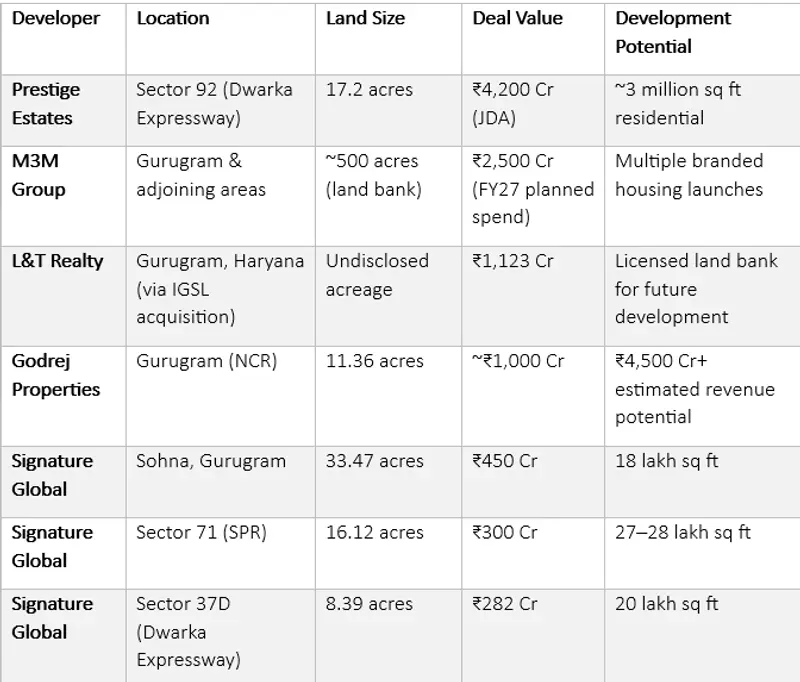
Adding up just these seven disclosed transactions crosses roughly ₹9,800 crore — comfortably past the ₹8,500 crore mark and confirming that this isn't a rounded-up estimate but a verifiable trend backed by regulatory filings and company disclosures.
This local surge also mirrors a nationwide pattern. Developers across India acquired over 3,093 acres through 149 transactions worth ₹54,818 crore in 2025 — a 32% year-on-year jump — and Tier-1 cities like Gurugram captured 89% of that capital while accounting for just 52% of the land area purchased. In other words, the money is concentrating in fewer, more expensive, more strategically located parcels — exactly the pattern visible in Gurugram's deal sheet above.
Corridor-by-Corridor: Where the Money Is Going
Dwarka Expressway: The Undisputed Magnet
Both Prestige Estates and Signature Global anchored major acquisitions along this corridor, and it's easy to see why. Once a peripheral stretch, Dwarka Expressway now offers direct connectivity to Delhi and IGI Airport, transforming sectors like 37D, 99, 110, and 113 from affordable outliers into premium addresses. Developers are positioning here for the same repricing effect that played out once the road became fully functional — buy the land before the next leg of appreciation, not after.
Sohna: The Quiet Expansion Zone
Signature Global's 33.47-acre Sohna acquisition signals a second theme: developers hedging toward the city's southern periphery, where land costs remain a fraction of central Gurugram while still benefiting from spillover demand and improving road connectivity to NH-48.
Southern Peripheral Road (SPR): The "Next Cyber City" Bet
SPR has already recorded close to 125% price appreciation over three years, and developer land acquisitions here suggest confidence that the corridor's evolution into a secondary commercial-residential hub is far from finished.
Sector 92 and Central Corridors: Premium Positioning
Prestige's Sector 92 deal — at roughly ₹244 crore per acre — reflects a different strategy entirely: paying a steep premium for a well-located, ready-to-develop parcel in a corridor with immediate absorption potential, rather than banking on future infrastructure to unlock value.
What This Means for Land Economics
The price-per-acre spread across these deals is instructive. Compare the numbers:
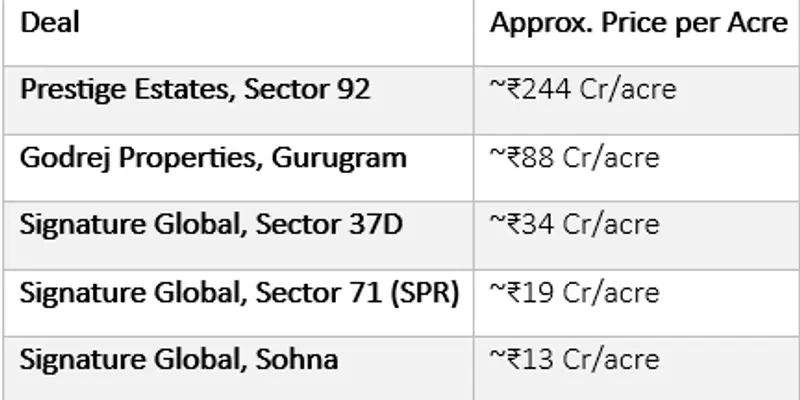
This roughly 18x spread between the cheapest and priciest parcel confirms that "Gurugram land" is not one market — it's a collection of distinct micro-markets pricing risk and readiness very differently. Central, expressway-adjacent parcels with immediate development potential command a massive premium over peripheral land banks bought for future optionality.
Risks Behind the Rush
Big capital deployment doesn't eliminate risk — it often just relocates it.
Execution risk is the biggest variable. L&T Realty's ₹1,123 crore acquisition of a company with zero revenue over three years — done purely to access its licensed land holdings — illustrates how much of this capital is a bet on future development rights rather than existing cash flow. If approvals, construction timelines, or market absorption slip, that capital sits idle far longer than models assume.
Affordability pressure could dent absorption. Industry voices have flagged that Gurugram's housing market, after a roughly 150% price rise since 2019, is entering a consolidation phase rather than further breakneck growth. Developers betting on land today are effectively betting that end-user and investor demand holds up even as home prices moderate.
Shadow inventory in certain sectors. Analysts have flagged that some peripheral sectors could see a glut of investor-held resale units hitting the market simultaneously, which could compress near-term returns for developers launching fresh supply in the same micro-markets.
Despite these risks, most developer commentary points toward "moderation, not correction" — a slower, more selective growth phase rather than a downturn, driven by continued corporate and GCC-led housing demand.
What This Means for Homebuyers and Investors
For homebuyers: This scale of land acquisition typically precedes a wave of new project launches 18–36 months out. If you're planning to buy in Dwarka Expressway, Sohna, or SPR, expect increased primary-market supply and, correspondingly, more choice — but also be prepared for entry prices in fresh launches to reflect these elevated land costs.
For investors: Land acquisition at this scale by listed, well-capitalized developers is generally a leading indicator of where the next appreciation cycle will concentrate. Corridors attracting the heaviest institutional land buying — Dwarka Expressway and SPR in particular — are worth tracking for early-stage entry, whether through primary bookings once projects launch or resale in adjacent, already-developed pockets.
For NRIs: Large, listed developers with strong balance sheets (Prestige, Godrej, M3M) generally carry lower execution risk than smaller regional players, which matters for buyers who can't inspect land parcels or construction progress in person. Sticking to projects from developers with a demonstrated land-to-launch track record reduces exposure to delays.
The Bigger Picture: A Structural Shift, Not a Bubble
What separates this land rush from speculative cycles of the past is who's doing the buying. These aren't small, undercapitalized players chasing quick flips — they're listed companies with public disclosure obligations, institutional shareholders, and multi-year development pipelines. Godrej Properties alone reported sales bookings rising 25% to ₹24,008 crore in the first nine months of the fiscal year, giving it the balance sheet to fund large land bets without overleveraging.
That combination — disciplined, well-funded developers concentrating capital in Tier-1 corridors with real infrastructure delivery — is what distinguishes a maturing market from a speculative one. Gurugram's ₹8,500 crore-plus land grab isn't a warning sign. It's a signal that the city's next development cycle is already being written into the ground beneath it.
FAQ Section
1. Why are developers buying so much land in Gurugram right now?
Developers are racing to secure land before further infrastructure delivery — particularly along Dwarka Expressway and SPR — pushes acquisition costs higher, while also diversifying their national portfolios into one of India's fastest-growing Tier-1 markets.
2. Which developers have made the biggest land acquisitions in Gurugram recently?
Prestige Estates (₹4,200 Cr, Sector 92), M3M Group (₹2,500 Cr planned land spend), L&T Realty (₹1,123 Cr), Godrej Properties (~₹1,000 Cr), and Signature Global (multiple deals totaling over ₹1,000 Cr) have led recent disclosed transactions.
3. Does heavy land buying mean new project launches are coming soon?
Yes, typically. Land acquisitions usually translate into project launches within 18–36 months, once approvals, licensing, and planning are completed — so buyers can expect fresh primary-market supply in these corridors over the next few years.
4. Is this land rush a sign of a real estate bubble in Gurugram?
Most industry analysts describe this as a maturing, infrastructure-driven growth phase rather than speculative overheating, pointing to record-low unsold inventory and steady end-user demand from corporate and GCC employment growth as stabilizing factors.
5. Which Gurugram corridors are attracting the most developer investment?
Dwarka Expressway and Southern Peripheral Road (SPR) are drawing the heaviest institutional land buying, followed by Sohna, given its lower entry cost and improving connectivity to NH-48.
6. Should homebuyers wait for new launches instead of buying resale now?
It depends on your goals. If you want lower entry costs and are comfortable with a 2–4 year wait, upcoming launches in these newly acquired corridors may offer value. If you need immediate possession or rental income, resale in already-established micro-markets remains the more reliable choice.