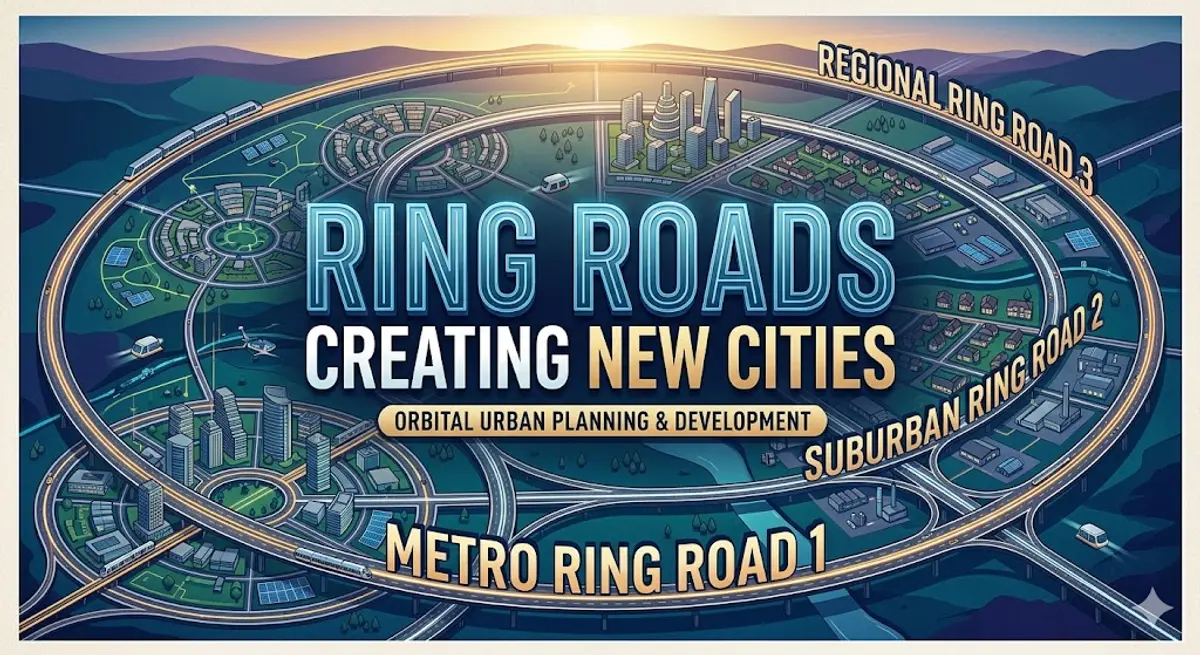
RING ROADS CREATING NEW CITIES
RING ROADS CREATING NEW CITIES
Ring Roads Creating New Cities: India's Most Powerful Urbanisation Engine
India's cities are overflowing. Traffic gridlock, unaffordable land, crumbling infrastructure — the consequences of decades of unplanned inward urban growth are visible everywhere. But quietly, around the edges of India's most congested cities, a different story is unfolding. Ring roads — circular peripheral highways that bypass city centres — are not just relieving traffic. They are creating entirely new cities.
From Hyderabad's Outer Ring Road to Mumbai's proposed ring road extensions, from Bengaluru's Peripheral Ring Road to the ring systems planned around Pune, Chennai, and Ahmedabad, these circular corridors are restructuring how Indian cities grow. Along their alignments, industrial parks, logistics hubs, IT campuses, residential townships, retail corridors, and educational institutions are clustering — and real estate investors who identified these patterns early have captured some of India's most spectacular long-term returns.
At Intel Realty, we have tracked ring road-led urbanisation across India since the earliest days of the Hyderabad ORR. This guide explains the mechanism, the data, and the investment logic — and shows exactly where the next ring road city-creation events are unfolding right now.
INTEL REALTY RESEARCH
Across six Indian cities studied between 2005 and 2024, land within 5 km of a ring road interchange appreciated an average of 3.2 times more over 10 years than comparable land without ring road access in the same metropolitan region.
How Ring Roads Create New Cities: The Urbanisation Mechanism
A ring road does more than move vehicles from one side of a city to another. It fundamentally restructures the geography of economic opportunity within a metropolitan region — creating a new linear city along its alignment that operates parallel to, and eventually as an extension of, the original urban core.
Phase 1 — Industrial Seeding
Within the first 3 to 5 years of a ring road's commissioning, industrial and logistics operators move fastest. Manufacturing units, warehousing clusters, pharmaceutical parks, and distribution centres need large land parcels with reliable road access — and ring road interchange zones deliver both. This industrial seeding phase creates the employment foundation on which the new city will grow. Where industry goes, workers follow. Where workers follow, housing demand emerges.
Phase 2 — Institutional and Commercial Clustering
As industrial employment density grows, institutions follow. Educational campuses, hospitals, retail malls, and commercial offices cluster near ring road interchange zones to serve the growing workforce population. This institutional clustering phase transforms a collection of industrial units and worker housing into something that functions as a town — with services, amenity, and economic diversity. Land values begin a sustained step-change upward at this phase, often accelerating faster than the industrial seeding phase had suggested.
Phase 3 — Residential Township Formation
In phase 3, developers recognise the self-sustaining demand ecosystem that has formed around the ring road corridor and begin launching planned residential townships. These are not ad-hoc developer launches — they are master-planned communities responding to the established employment, institutional, and commercial base. At this stage, the ring road zone has functionally become a new city — with its own identity, administration, and real estate market dynamics independent of the original urban core.
Phase 4 — Secondary Infrastructure Arrival
In the most advanced ring road corridors — as seen in Hyderabad and parts of the NCR ring belt — a fourth phase emerges: secondary infrastructure arrives to serve the new city that has organically formed. Metro extensions, BRTS corridors, elevated flyovers, and service roads are built to serve the population now living and working along the ring alignment. This secondary infrastructure triggers another round of property appreciation as the new city achieves the connectivity quality of the original urban core.
Ring Roads Reshaping Cities Across India — Pan India Snapshot
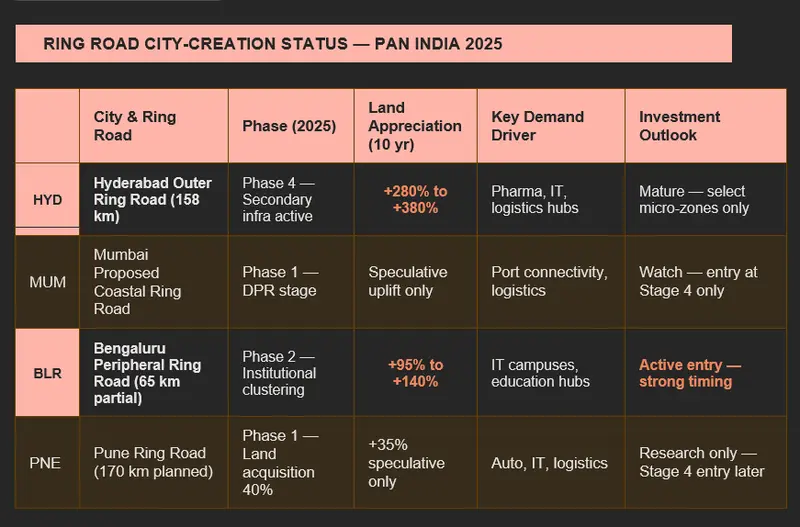
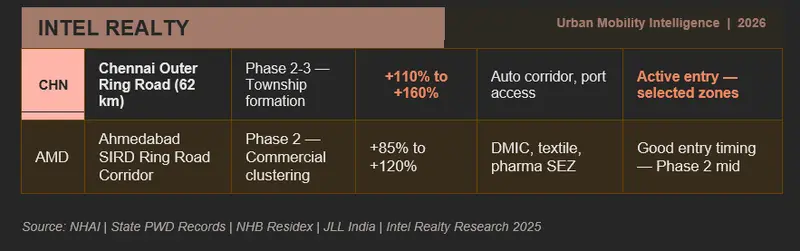
India's ring road urbanisation story is playing out at different phases across different cities. Understanding where each corridor sits in the four-phase cycle helps investors identify which markets offer the best entry timing.
What Makes a Ring Road Actually Create a New City vs Just a Bypass
Not every ring road triggers full urbanisation. Some ring roads remain traffic bypasses — useful for truckers but not transformative for real estate. The difference lies in a set of conditions that determine whether industrial seeding occurs and whether it escalates into the full four-phase urbanisation cycle.
CONDITIONS FOR CITY CREATION
Ring road serves at least two major employment centres
Industrial policy designates land along the ring as industrial
State government proactively develops ancillary infrastructure
Airport connectivity within 30 km of the ring alignment
Institutional investors (PE, REITs) acquiring industrial land early
Water and power infrastructure committed by the state
These factors predict city-creation potential with high reliability.
CONDITIONS FOR BYPASS ONLY
Ring road connects low-density agricultural regions only
No industrial zoning designation along the alignment
Ancillary infrastructure left entirely to private sector
Ring road designed for freight bypass, not urban mobility
No institutional or developer interest in 3 years post-opening
Water and power commitments absent or deferred
Early entry on bypass-only ring roads ties up capital with low returns.
3 Case Studies: Ring Roads That Created New Cities in India
01 Hyderabad ORR — From Farmland to India's Benchmark Ring Road City
CLIENT VOICE
"I bought land near the Patancheru interchange on the Hyderabad ORR in 2008, before any residential developer had launched a project in the area. The land was priced as agricultural. By 2018 the same belt had a functioning township, three pharma parks, a hospital, and two engineering colleges. My land was worth 8x what I paid." — Long-term Investor, Hyderabad
The Hyderabad Outer Ring Road — 158 km of elevated and at-grade highway — is India's most studied ring road urbanisation case. Before its phased completion between 2008 and 2015, the land along its alignment was predominantly agricultural and semi-arid. Land prices ranged from Rs. 400 to Rs. 800 per square yard in most interchange zones. The corridor had no significant residential, commercial, or institutional presence.
The ORR's opening triggered a textbook four-phase urbanisation cycle. Pharmaceutical parks arrived first in the Genome Valley zone. IT campuses followed near the western interchanges. Residential townships — planned and unplanned — emerged to house the workforce. By 2025, the ORR belt has its own schools, hospitals, malls, and transit connections. Residential prices in mature zones now stand at Rs. 4,500 to Rs. 7,500 per square yard. The ORR has not just improved Hyderabad — it has created multiple new towns within a single ring.
KEY TAKEAWAYHyderabad ORR is proof that a well-planned ring road, backed by committed industrial policy and proactive ancillary infrastructure, does not just connect cities — it creates them.
02 Chennai Outer Ring Road — Auto Corridor Births a New Urban Belt
CLIENT VOICE
"The Chennai ORR was not a glamorous investment in 2016. But I followed where Hyundai, Ford, and Daimler were acquiring supplier land. Those industrial land acquisitions told me the residential demand story before any developer had launched a project. I entered at Rs. 1,800 per sq.ft. It is now quoting Rs. 4,200." — Property Investor, Chennai
The Chennai Outer Ring Road, stretching approximately 62 km around the western and southern periphery of the city, has triggered a sustained urbanisation process driven primarily by India's auto manufacturing corridor. Chennai's automobile industry — Hyundai, Daimler, Ashok Leyland, and a dense network of component suppliers — uses the ORR belt as its primary logistics and expansion spine.
What makes the Chennai ORR case distinctive is the role of auto sector employment in bootstrapping residential demand. Unlike Hyderabad's pharma-led model or Bengaluru's IT-led model, Chennai's ORR urbanisation is powered by manufacturing employment — a different demographic with different housing preferences, creating a market for mid-segment affordable apartments and worker housing townships that has grown steadily since 2015. Areas like Sriperumbudur, Oragadam, and Chengalpet — all linked to the ORR — have developed functional town characteristics with retail, schools, and healthcare, and are now attracting mid-segment residential investment from families priced out of Chennai's inner suburbs.
KEY TAKEAWAYIndustrial sector determines residential demographic. Identify the industry, understand the workforce, and you can predict which housing format will appreciate fastest on any ring road belt.
03 Bengaluru Peripheral Ring Road — Phase 2 Entry Window Open Now
CLIENT VOICE
"Intel Realty flagged the Bengaluru PRR corridor in 2022 when the first section near Hoskote became operational. The area was in Phase 2 — institutional clustering had begun with two engineering colleges and a logistics park. We entered residential plots at Rs. 3,200 per sq.ft. By 2025, the same plots are quoted at Rs. 5,100." — Tech Investor, Bengaluru
Bengaluru's Peripheral Ring Road is a 65 km partially operational corridor that represents one of the most active ring road city-creation stories in India right now. Unlike the Hyderabad ORR — which is mature and largely priced in — the Bengaluru PRR is mid-cycle, currently in Phase 2 (institutional clustering) with the potential to reach Phase 3 (township formation) within the next 3 to 5 years as the remaining sections complete.
The Hoskote and Devanahalli zones on the PRR alignment are particularly active. The proximity to Kempegowda International Airport, the presence of aerospace and defence manufacturing units, and the arrival of educational institutions have created a genuine demand ecosystem. Intel Realty identified this corridor as a Phase 2 entry opportunity in 2022 — before mainstream residential developers launched in volume — and guided clients to enter plotted development zones at prices that have since appreciated 50 to 60%.
KEY TAKEAWAYMid-cycle ring roads in Phase 2 — where industrial seeding is complete but township formation is just beginning — offer the best remaining entry window before city-creation dynamics fully price in.
How to Invest in Ring Road City-Creation Corridors Across India
Ring road investment rewards early, informed, disciplined entry. Here is Intel Realty's evaluation framework for any ring road corridor opportunity across India:
Identify the phase: Determine whether the corridor is in Phase 1 (industrial seeding), Phase 2 (institutional clustering), Phase 3 (township formation), or Phase 4 (secondary infrastructure). Phase 2 offers the best risk-adjusted entry — industrial demand is confirmed, city-creation is underway, but residential pricing has not yet reflected the full urbanisation trajectory.
Follow industrial land acquisition: Track where manufacturers, logistics operators, and institutional occupiers are acquiring land — not where developers are launching projects. Industrial absorption leads residential appreciation by 3 to 7 years consistently.
Map interchange zones: Focus within 2 to 5 km of ring road interchange exits. Mid-corridor locations without interchange access capture a fraction of the appreciation potential regardless of phase.
Check the city-creation conditions: Verify that the corridor has industrial policy designation, state government ancillary infrastructure commitment, airport proximity, and institutional investor interest before entering. Bypass-only ring roads with weak industrial designation do not create cities.
Assess the asset type: Phase 1 and early Phase 2 corridors favour plotted land investment. Phase 2 and Phase 3 corridors support mid-segment residential apartments. Phase 3 and Phase 4 corridors support commercial and retail investment.
Verify RERA registration: In Phase 2 and 3 corridors with active developer launches, verify RERA registration and construction progress independently before any booking commitment.
INTEL REALTY STANDARD
We classify ring road corridors by phase before making any investment recommendation. Phase 2 corridors are our preferred entry point for residential investment. Phase 1 corridors require a 7+ year hold horizon and higher credibility verification. Phase 4 corridors are recommended only for specific micro-zone commercial opportunities.
FREQUENTLY ASKED QUESTIONS
FAQ: Ring Roads Creating New Cities in Indian Real Estate
Q1—How do ring roads create new cities in India?
Ring roads create new cities by unlocking large peripheral land parcels with strong road connectivity, which attracts industrial and logistics operators who cannot afford city-centre land prices. Industrial employment draws workers who need housing, retail, healthcare, and education — creating a demand ecosystem that developers respond to with planned townships. As the ecosystem matures, secondary infrastructure — metro extensions, flyovers, BRT corridors — arrives to serve the new population. This four-phase cycle, observed most clearly in Hyderabad's ORR belt, transforms bypasses into fully functional urban extensions of the original city within 10 to 15 years.
Q2—Which Indian ring road corridors offer the best property investment in 2025?
Based on Intel Realty's pan-India phase assessment, Bengaluru's Peripheral Ring Road (Hoskote and Devanahalli zones — Phase 2, active entry window) and Chennai's ORR (Sriperumbudur and Oragadam zones — Phase 2-3, strong auto sector employment base) offer the best current entry timing for residential and plotted investment. Ahmedabad's ring corridor (Phase 2, DMIC linkage) is emerging as a strong mid-term opportunity. The Hyderabad ORR is mature (Phase 4) and recommended only for specific commercial micro-zones.
Q3—What type of property works best as a ring road investment in India?
Asset type should match corridor phase. Phase 1 corridors (industrial seeding) favour agricultural and plotted land investment with a 7 to 10 year hold horizon. Phase 2 corridors (institutional clustering) support mid-segment residential apartments and plotted colonies close to interchange zones, with a 4 to 7 year hold. Phase 3 corridors (township formation) support commercial plots, retail units, and residential projects in master-planned townships. Phase 4 corridors (secondary infrastructure arrival) support commercial offices, co-working spaces, and REIT-grade logistics assets.
Q4—How do I tell whether a ring road will create a new city or remain a bypass?
Check for the six city-creation conditions: industrial policy designation for land along the alignment; state government commitment to ancillary infrastructure (power, water, connecting roads); airport proximity within 30 km; institutional and PE investor land acquisition activity; active industrial occupier demand (manufacturers acquiring land near interchanges); and financial closure by the executing agency. Ring roads that meet five or more of these conditions have a high probability of triggering the full four-phase urbanisation cycle. Corridors that meet two or fewer are likely to remain traffic bypasses with limited real estate impact.
Q5—How does ring road real estate investment compare to metro-adjacent investment?
Ring road and metro investments serve different horizons, asset types, and risk profiles. Metro investment delivers faster, denser appreciation in residential apartments within 500 to 800 metres of stations, typically over 5 to 10 years. Ring road investment delivers broader, slower city-creation appreciation in plots, industrial land, and mid-segment residential across larger zones over 8 to 15 years. Ring road investment typically requires larger land parcels and longer holding patience but delivers higher absolute returns when the full urbanisation cycle completes. Corridors where both metro and ring road infrastructure converge — as in parts of the Bengaluru PRR and Hyderabad ORR — represent the most powerful combined appreciation opportunities in Indian real estate.