
Scaling Your Brokerage: Growth Strategies for Real Estate Agencies in Gurgaon's Premium Segment
Introduction
Real estate agencies scaling from solo operations to multi-agent powerhouses face distinct growth challenges. Gurgaon's market leaders managing 20-50 agent teams generate INR 50-150 crores annual revenue demonstrating extraordinary scalability. Yet most brokerages stagnate at 5-10 agent operations lacking systematic growth frameworks.
Scaling requires disciplined systems: recruitment, training, technology infrastructure, and financial management. Agencies implementing structured growth strategies capture market leadership positioning and sustainable profitability. This comprehensive guide reveals scaling strategies enabling real estate agencies to dominate Gurgaon's premium segment in 2026.
Understanding Brokerage Scaling Economics
Scaling transforms brokerage economics fundamentally. Understanding unit economics reveals growth pathways.
Solo Operator Profitability Constraints
Solo agents completing 20-30 transactions annually at INR 2-3 crore average generating INR 60-180 lakhs gross commission. After operational costs (office, marketing, technology), net income reaches INR 30-80 lakhs. Solo model ceiling emerges through time constraints limiting transaction volume.
Multi-Agent Scalability Model
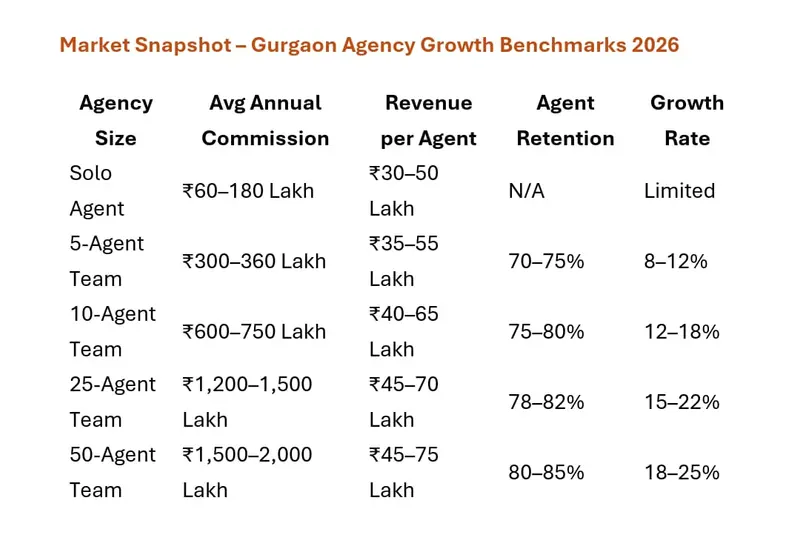
Five-agent teams completing 100-120 aggregate transactions annually generate INR 300-360 lakhs gross commission. Per-agent productivity stabilizes at 20-24 transactions. Agency retains 25-30% commission (INR 75-108 lakhs) after agent splits, covering overhead and profits. Scaling reveals leverage through shared infrastructure reducing per-agent costs.
Ten-agent teams reaching 200-250 transactions generate INR 600-750 lakhs gross revenue. Agency retains INR 150-225 lakhs after splits. Economies of scale improve per-unit overhead. Fifty-agent enterprises generate INR 1,500-2,000 lakhs gross with INR 375-600 lakhs agency retention demonstrating extraordinary profitability.
Revenue Per Agent Evolution
Growing agencies demonstrate increasing revenue per agent through improved systems. Solo agents average INR 30-50 lakhs annual commission income. Five-agent team members average INR 35-55 lakhs through better client access and support systems. Fifty-agent enterprises achieve INR 45-75 lakhs per agent through infrastructure quality and brand positioning.
Why Emerging Corridors Enable Rapid Agency Expansion
Gurgaon's expanding luxury zones create growth opportunity for agencies building early market presence.
Market Entry Advantage in Emerging Zones
Agencies establishing Sector 52 and Sector 43 presence during 2025-2026 development phases capture early-mover positioning. Emerging zones generate 20-30% annual growth compared to established market 5-8% growth. Growth-stage markets accelerate agent productivity and revenue acceleration.
Talent Acquisition in Growth Markets
Emerging zone agencies attract ambitious agents seeking rapid career advancement. Growth-stage markets enable agents to build personal brands through new market development. Sector 52 specialists building reputation during emergence gain founder status for emerging markets.
Multi-Agency Competition Delay
Emerging corridors initially attract limited competitive brokerages. Early entrant agencies establish market presence before competitive density. Sector 52 currently hosts 15-20 active brokerages versus Sector 65 150+ brokerages. Early positioning enables sustainable competitive advantage.
Developer Relationship Priority
Emerging zone developers prioritize establishing broker relationships. Early agencies securing developer partnerships gain allocation advantages preventing later competitive erosion. Developer allocation provides stable revenue supporting team expansion investment.
Key Indicators of Sustainable Agency Growth
Professional agencies apply systematic evaluation frameworks measuring growth trajectory.
Agent Retention Rate Measurement
Successful agencies maintain 75-85% annual agent retention versus market average 55-65%. Retention below 60% indicates organizational dysfunction or competitive poaching. Track retention by agent tenure—new agent retention (first 12 months) averages 40-50%; established agent retention (2+ years) reaches 80-90%.
High-retention agencies demonstrate superior culture and support systems. Retention investment in training, mentoring, and compensation justifies return through reduced recruitment costs.
Revenue Per Agent Tracking
Monitor revenue per full-time equivalent agent measuring productivity. Growing agencies demonstrate 8-12% annual revenue per agent improvement. Stagnant agencies show flat-to-declining per-agent metrics indicating system constraints. Compare per-agent performance against market benchmarks identifying competitive positioning.
Market Share Concentration
Growing agencies gain market share within target segments. Track transaction volume and revenue share against primary competitors. Agency growing 20%+ annually while competitors grow 5-8% indicates market share gain. Expanding market share justifies ongoing investment in growth infrastructure.
Team Productivity Metrics
Monitor transactions per agent, average deal value, and sales cycle efficiency. Productive agencies demonstrate standardized processes enabling consistent agent output. Agencies with high variance between agent productivity indicate process weaknesses requiring optimization.
Top Gurgaon Growth Opportunity Corridors
Sector 65 – Mature market density, Differentiation required, Team specialization opportunity
Sector 52 – High-growth zone, Early-mover expansion opportunity, Developer partnership potential
Golf Course Road – Premium positioning market, Lifestyle specialization growth, Luxury segment concentration
Cyber Hub Area – Tech professional concentration, Professional network expansion, Corporate relocation opportunity
Manesar-Bawal – Emerging expansion frontier, Portfolio investor attraction, Investment thesis positioning
Market Snapshot – Gurgaon Agency Growth Benchmarks 2026
Strategic Agency Growth & Scaling Tips
Build Systematized Sales Processes
Document standardized sales methodologies enabling consistent agent productivity. Process documentation enables rapid onboarding of new agents. Systems-based agencies demonstrate 20-30% higher agent productivity versus process-improvisation approaches. Invest in process development before team expansion ensuring quality consistency.
Implement Robust Technology Infrastructure
Deploy sophisticated CRM, lead management, and transaction systems supporting team operations. Technology investment of INR 20-40 lakhs annually scales across growing teams. Modern CRM systems enable lead routing, automated follow-up, and performance tracking. Technology enables agency operations scaling without proportional management overhead.
Establish Structured Recruitment & Training
Create formal recruitment and 90-day onboarding programs. Structured training reduces new agent failure rates from 40-50% to 15-20%. Documented training curriculums standardize knowledge transfer enabling rapid scaling. Recruitment focused on cultural fit and coachability maximizes retention and productivity.
Develop Specialized Team Verticals
Organize growing teams into specialization verticals: NRI investor teams, emerging corridor specialists, luxury lifestyle teams, or investor portfolio brokers. Vertical specialization enables deep expertise differentiation. Specialized teams command premium positioning and higher commission retention.
Incentive Alignment & Compensation Structure
Design compensation structures aligning agent interests with agency growth. Performance-based bonuses rewarding top performers drive excellence and retention. Revenue sharing models enabling productive agents to capture upside create loyalty. Competitive compensation attracts and retains high-performing talent.
Build Brand Positioning & Thought Leadership
Establish agency brand through market research, content marketing, and publication features. Agency thought leadership attracts talent and client preference. Invest in content creation, market intelligence, and executive visibility building agency reputation.
Expand Geographic Footprint Strategically
Open new office locations in target corridors providing on-ground presence and client accessibility. Emerging zone offices capturing early-stage market development offer competitive advantage. Geographic expansion requires 15-18 months establishing operations before profitability. Plan expansion during strong cash flow periods enabling investment.
Develop Strategic Partnerships & Alliances
Build relationships with complementary service providers (finance advisors, legal consultants, property managers) creating integrated service ecosystems. Partnerships expand service value proposition differentiating from transaction-focused competitors. Alliance relationships generate referral flow accelerating growth.
Create Mentorship & Leadership Development
Identify high-performing agents with leadership potential. Structured mentorship programs developing future team leads enable scaling beyond founder capacity. Leadership development creates career pathways retaining top talent through advancement opportunities.
Monitor Financial Health & Profitability
Track agency profitability carefully. Growing agencies require profitable underlying business supporting expansion investment. Monitor commission retention (gross minus agent splits), overhead costs, and net margins. Unprofitable growth creates unsustainable models collapsing during market downturns.
Growth Investment Timing & Capital Requirements
Sustainable scaling requires capital. Growing from 5 to 10 agents requires INR 30-50 lakhs investment in technology, training, and additional infrastructure. Growing to 25 agents requires INR 75-125 lakhs cumulative investment. Fifty-agent operations require INR 200-300 lakhs infrastructure investment. Plan scaling during strong cash flow periods enabling self-funded expansion.
Conclusion: Disciplined Scaling as Competitive Differentiator
Real estate agency scaling transforms business economics creating sustainable profitability and market leadership. Agencies implementing systematic growth strategies capture 3-5x revenue multiples versus stagnant solo operations. Gurgaon's market leaders demonstrate extraordinary scaling reaching 50-100 agent operations generating INR 100-200 crores annual revenue.
Success requires systematized processes, robust technology infrastructure, structured recruitment, and disciplined financial management. Emerging corridor growth opportunities accelerate scaling through market expansion. Early positioning in Sector 52 and Sector 43 enables rapid team growth capturing high-growth market dynamics.
Agencies investing in scalable systems, talent development, and strategic positioning build institutional advantages supporting long-term growth. Scaling requires patience, discipline, and capital investment—but rewards ambitious agencies with market leadership and extraordinary profitability.
Frequently Asked Questions
Q1: What's the optimal timeline for growing from solo operation to multi-agent team?
Strategic growth spans 18-36 months scaling from solo to 10-agent team. Initial 2-3 years building systems and establishing market position provide foundation. First agent hire typically occurs when solo operator generates consistent INR 100+ lakhs annual income. Subsequent agent additions accelerate once systems support productivity. Rapid scaling before system readiness creates quality deterioration and retention problems.
Q2: How much capital investment is required to scale brokerage in Gurgaon?
Scaling to 5-agent team requires INR 25-40 lakhs technology and infrastructure investment. 10-agent operations require INR 50-80 lakhs cumulative investment. 25-agent teams require INR 100-150 lakhs. 50-agent enterprises require INR 250-400 lakhs infrastructure investment. Most scaling occurs through reinvested profits—capital efficiency proves critical.
Q3: What agent retention rates should growing agencies target?
Market-leading agencies maintain 80-85% annual agent retention. Growing agencies target 75-80% retention demonstrating organizational health. Retention below 60% indicates recruitment/training problems requiring systematic intervention. New agent retention (first year) averages 40-50%—higher retention requires structured onboarding programs.
Q4: Which Gurgaon locations offer best growth opportunity for expanding agencies?
Emerging zones like Sector 52 and Sector 43 offer 20-30% annual growth versus established market 5-8% growth. Early agency positioning in emerging zones accelerates scaling through market expansion. Established zones like Sector 65 require specialization differentiation. Balanced geographic strategy combines emerging zone growth with established zone specialization.
Q5: How should agencies structure compensation for growing teams?
Base compensation + performance bonuses optimize retention and productivity. Entry-level agents: 50-60% commission split encouraging productivity. Experienced agents: 60-70% splits rewarding loyalty. Top performers: 70-80% splits capturing revenue. Revenue-sharing models enabling agents capturing percentage of office profitability create ownership mentality.
Q6: What metrics indicate unsustainable growth creating future problems?
Declining revenue per agent while agent count grows signals quality deterioration. Rapidly deteriorating agent retention (below 50%) indicates burnout or culture problems. Negative office profitability despite revenue growth indicates cost structure problems. Commission retention declining below 25% suggests pricing pressure or operational inefficiency. Monitor these metrics preventing unsustainable growth patterns.