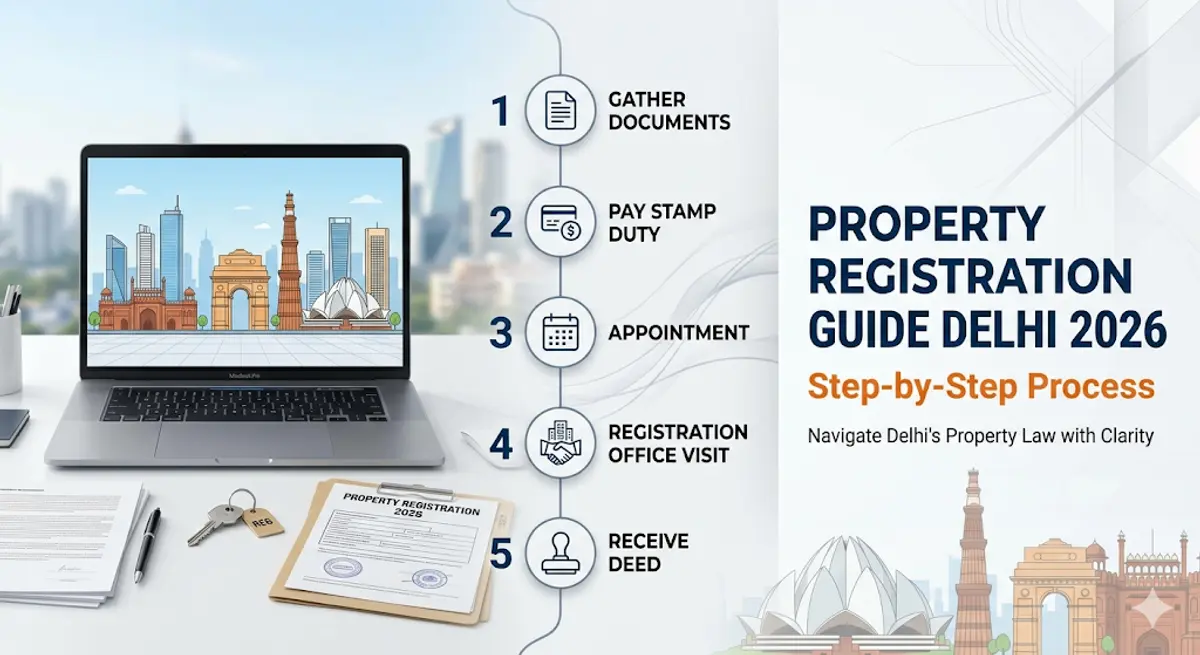
Property Registration Guide Delhi 2025 | Step-by-Step Process
Property Registration Guide Delhi 2025 | Step-by-Step Process
Why Property Registration is Non-Negotiable
Property registration under the Registration Act, 1908 is mandatory for all immovable property transactions in India. An unregistered property document does not legally transfer ownership, leaving the buyer without enforceable legal title.
In Delhi, all property transactions above ₹100 must be registered at the appropriate Sub-Registrar Office (SRO).
Step-by-Step Registration Process in Delhi
Step 1 — Prepare Documents: Collect original Sale Deed (drafted by a lawyer), identity proofs (Aadhaar, PAN) for all parties, passport-size photographs, No Objection Certificate from the builder or RWA, and proof of stamp duty payment.
Step 2 — Pay Stamp Duty: Pay stamp duty online via the SHCIL (Stock Holding Corporation of India Ltd) portal or at authorized banks. Obtain e-stamps for the applicable value.
Step 3 — Book Appointment: Book an appointment at the relevant Sub-Registrar Office via the Delhi government's online portal (doris.delhigovt.nic.in). Select the SRO based on the property's location.
Step 4 — Visit the SRO: Both buyer and seller (and witnesses) must be physically present at the SRO on the appointed date with original documents and identity proofs.
Step 5 — Biometric and Photograph: The SRO will capture biometric data (fingerprints) and photographs of all parties. The document will be scanned and a receipt issued.
Step 6 — Receive Registered Document: The registered Sale Deed is typically returned within 3–7 working days or can be tracked online.
Documents Required for Registration
Original Sale Deed (minimum one buyer-side and one seller-side copy), e-stamp papers of the required value, Form No. 1 (application for registration), identity proofs of all parties (Aadhaar + PAN mandatory), two witnesses with identity proofs, latest property tax receipt, and NOC from housing society or builder.
Common Mistakes at Registration
Mismatch between the name on identity documents and the Sale Deed — ensure names are perfectly consistent across all documents. Incorrect stamp duty calculation — even minor under-stamping can cause issues during future resale.
Forgetting to register within 4 months of execution — the Sale Deed must be registered within 4 months of its execution date to avoid penalty surcharges.
Conclusion
Property registration in Delhi is a structured process that protects buyers' legal rights. Following the steps outlined, preparing documents carefully, and avoiding common mistakes ensures a smooth registration experience.