
PORTFOLIO DIVERSIFICATION: ALLOCATING TO ULTRA-LUXURY REAL ESTATE IN GURGAON
Introduction
High-net-worth individuals and institutional investors increasingly view ultra-luxury real estate as portfolio core holding rather than single-property acquisition. Strategic allocation to Gurgaon properties strengthens overall portfolio diversification while generating consistent income and capital appreciation. Sophisticated investors structure multi-property portfolios across corridors, sectors, and property types, optimizing risk-adjusted returns.
This guide addresses portfolio allocation strategies for ultra-luxury real estate positioning in comprehensive wealth management frameworks.
Why Ultra-Luxury Real Estate Deserves Portfolio Allocation
Low Correlation with Equities and Bonds
Ultra-luxury real estate demonstrates low correlation with equity markets and fixed-income securities. Property valuations driven by physical scarcity, construction costs, and local supply-demand dynamics operate independently from stock market cycles. Portfolio diversification across asset classes reduces overall volatility.
Real estate allocation reduces portfolio sensitivity to equity market corrections.
Tangible Asset Backing and Physical Security
Properties represent tangible assets with underlying land value and construction costs providing price floors. Unlike equity holdings or bonds, real estate cannot disappear or become worthless. Physical asset backing provides psychological and financial security during market volatility.
Tangible assets provide fundamental portfolio security.
Inflation Hedge and Real Return Generation
Real estate appreciation historically outpaces inflation, preserving purchasing power across decades. Rental income and property values both rise with inflation, protecting wealth against currency debasement. Long-term portfolio holders benefit from inflation protection.
Real estate provides reliable inflation hedge across economic cycles.
Income Generation and Cash Flow
Ultra-luxury properties generate consistent rental income independent of equity market performance. Rental yields of 2.5-4.0% provide meaningful portfolio cash flow. Income-producing assets improve overall portfolio cash flow characteristics.
Rental income supports portfolio liquidity independent of market conditions.
Strategic Allocation Framework
Determining Optimal Real Estate Allocation
Conservative portfolios (risk-averse investors) allocate 15-25% to real estate, emphasizing established sectors and rental income. Balanced portfolios allocate 25-35% to real estate, mixing established stability with emerging zone growth. Growth portfolios allocate 35-50% to real estate, emphasizing appreciation potential and emerging corridors.
Allocation percentage depends on overall wealth, risk tolerance, and investment objectives.
Corridor and Sector Diversification
Diversify across multiple corridors—Golf Course Road (stability), Sector 109-110 (growth), Manesar Extension (emerging). Sector diversification reduces concentration risk while capturing different return characteristics. Multi-corridor positioning provides balanced exposure across market cycles.
Corridor diversification optimizes risk-adjusted returns across Gurgaon's opportunity set.
Property Type Diversification
Allocate across property types—apartments (liquidity), villas (space-value), mixed-use (commercial exposure). Property type diversification captures different tenant bases and appreciation profiles. Diversified holdings reduce dependency on single property type performance.
Multi-property-type portfolios optimize risk characteristics and return generation.
Holding Period Diversification
Portfolio combining short-term properties (3-5 years), medium-term holdings (5-10 years), and long-term core assets (10+ years) creates staggered liquidity and appreciation realization. Diversified holding periods reduce timing pressure and enable strategic capital deployment.
Holding period diversification optimizes portfolio cash flow and liquidity management.
Top Gurgaon Locations for Portfolio Construction
Tier 1: Core Holdings (Golf Course Road, DLF Phase 5)
Established ultra-luxury sectors forming portfolio foundation. Properties valued ₹6-10 crore generating 2.5-3.0% yields with 6-8% appreciation. Core holdings provide stability, consistent income, and wealth preservation across market cycles.
Core portfolio allocation: 40-50% of real estate holdings.
Tier 2: Growth Holdings (Sector 109-110, Sector 46)
Emerging-to-established transition zones capturing appreciation potential with modest execution risk. Properties valued ₹3.5-5.5 crore generating 3.2-3.8% yields with 8-11% appreciation. Growth holdings drive portfolio appreciation while maintaining fundamentals.
Growth portfolio allocation: 30-40% of real estate holdings.
Tier 3: Emerging Opportunities (Manesar, Dwarka Expressway)
Early-stage development zones offering maximum appreciation potential with moderate risk. Properties valued ₹2.8-4.5 crore generating 3.5-4.0% yields with 9-12% appreciation. Emerging allocations capture market-discovery gains before mainstream recognition.
Emerging portfolio allocation: 15-25% of real estate holdings.
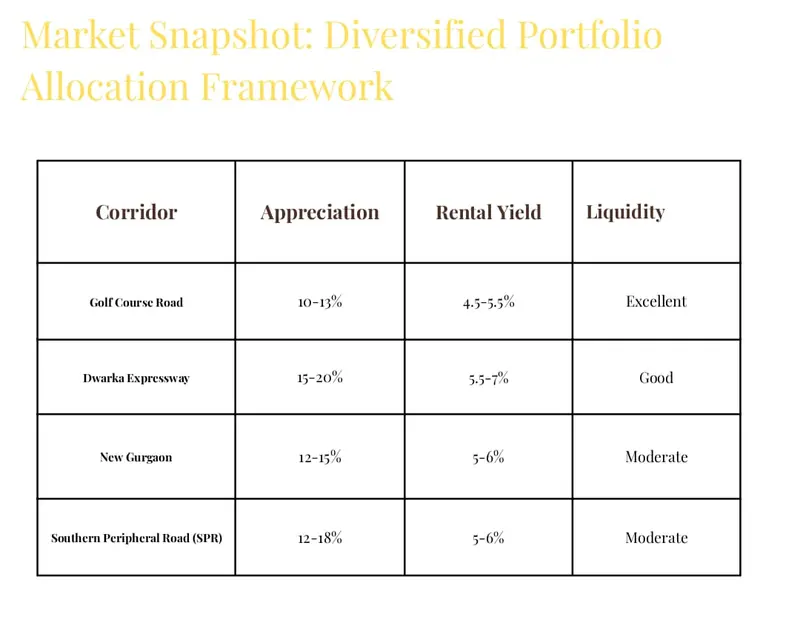
Market Snapshot 2026
Portfolio Allocation Tips
Start With Core Foundation
Begin portfolio construction with established sector core holdings providing stability and income. 40-50% core allocation anchors portfolio with consistent performance. Foundation building creates portfolio backbone for subsequent diversification.
Strong core foundation supports subsequent growth allocation.
Build Growth Tier Systematically
Add 30-40% growth allocation across emerging-to-established transition zones. Systematic growth tier construction captures appreciation without excessive risk concentration. Staged growth building scales portfolio risk exposure appropriately.
Systematic growth tier development optimizes risk-adjusted accumulation.
Allocate Emerging Opportunities Strategically
Reserve 15-25% for emerging zones offering highest appreciation potential. Strategic allocation enables capturing emerging market gains while limiting exposure to early-stage execution risk. Emerging allocation creates portfolio growth drivers.
Strategic emerging allocation drives long-term wealth accumulation.
Rebalance Annually
Review portfolio quarterly and rebalance annually. Properties approaching maturity transition from growth to core allocation. Systematic rebalancing maintains target allocation percentages across tiers.
Annual rebalancing optimizes portfolio positioning across cycles.
Monitor Corridor Performance
Track appreciation and rental trends across corridors. Shift allocations based on changing fundamentals and market developments. Performance monitoring ensures portfolio remains aligned with objectives.
Data-driven allocation adjustments optimize outcomes.
Conclusion
Ultra-luxury real estate allocation strengthens portfolio diversification while generating consistent income and capital appreciation. Strategic allocation across core (40-50%), growth (30-40%), and emerging (15-25%) tiers balances stability with appreciation potential. Corridor diversification and holding period staggering optimize risk-adjusted returns across market cycles.
HNI investors and family offices implementing comprehensive allocation frameworks capture real estate benefits—inflation protection, income generation, and tangible asset backing—while maintaining overall portfolio balance and liquidity.
Build your ultra-luxury real estate portfolio strategically. Connect with portfolio specialists who design allocation frameworks aligned with your wealth objectives and risk profile in Gurgaon's diversified opportunity landscape.
FREQUENTLY ASKED QUESTIONS
Q: What percentage of wealth should allocate to ultra-luxury real estate?
A: Allocation depends on risk tolerance and objectives. Conservative investors: 15-25%. Balanced investors: 25-35%. Growth-focused investors: 35-50%. Consult wealth advisors to determine optimal allocation for your specific circumstances, overall portfolio composition, and financial goals.
Q: Should I concentrate portfolio in single corridor or diversify?
A: Diversification reduces risk significantly. Multi-corridor allocation captures different return profiles—established sectors for stability, emerging zones for growth. Concentrated portfolios amplify both upside and downside. Diversified positioning optimizes risk-adjusted returns across Gurgaon's corridor ecosystem.
Q: How often should portfolio rebalancing occur?
A: Annual comprehensive rebalancing with quarterly performance monitoring maintains target allocation percentages. Properties transitioning from growth to core tier trigger rebalancing adjustments. Regular monitoring ensures portfolio alignment with objectives and changing market dynamics.
Q: What's optimal property count for ultra-luxury portfolio?
A: Typical ultra-HNI portfolios contain 4-8 properties across corridors and property types. Diversification benefits plateau beyond 8-10 properties with management complexity increasing. Optimal count balances diversification benefits against management overhead and capital efficiency.
Q: How does real estate improve overall portfolio risk profile?
A: Real estate's low equity correlation (−0.1 to +0.2) reduces overall portfolio volatility. Adding real estate to equity-dominated portfolios reduces sensitivity to equity market corrections. Income generation provides cash flow independent of market conditions. Tangible assets provide psychological security during volatility.
Q: Should emerging properties receive higher allocation for growth portfolios?
A: Growth portfolios can allocate up to 25-30% to emerging zones for appreciation capture. However, execution risk and development timelines suggest limiting emerging allocation to manageable percentages. Balance emerging opportunity with core stability to weather execution delays without portfolio stress.