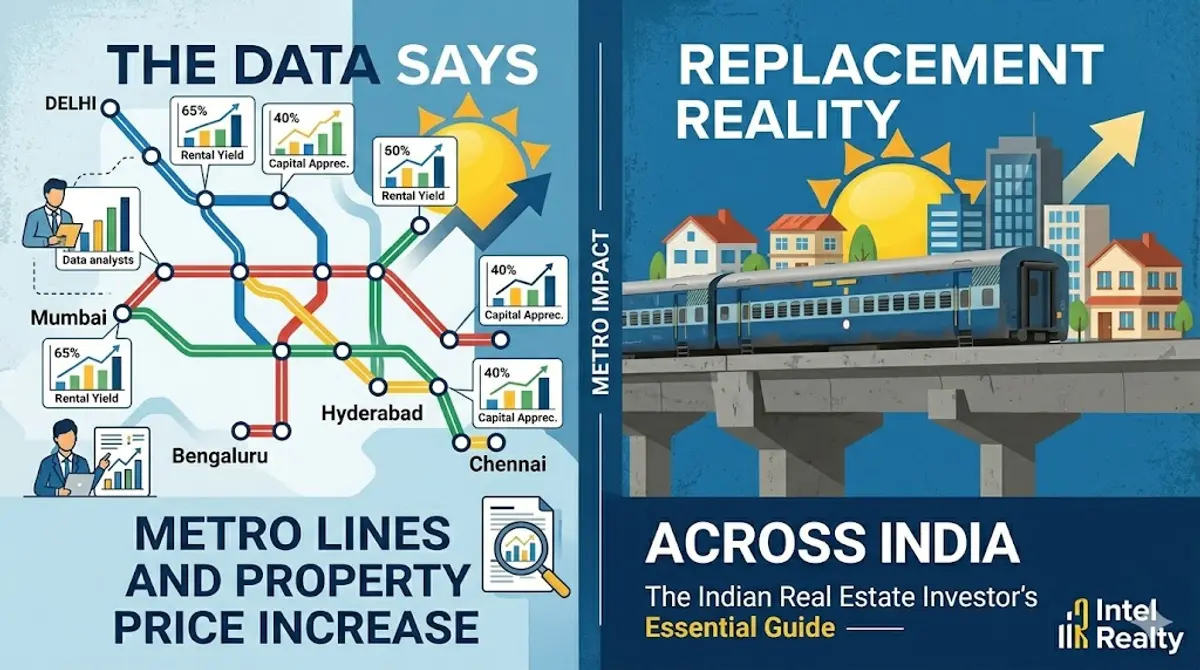
Metro Lines and Property Price Increase: What the Data Says Across India
Metro Lines and Property Price Increase: What the Data Says Across India
Of all the infrastructure investments that move real estate values in India, metro rail consistently delivers the most measurable, most studied, and most replicable impact on residential and commercial property prices. From Delhi to Bengaluru, from Mumbai to Hyderabad, the pattern repeats with remarkable consistency — metro connectivity drives property appreciation, and the investors who enter at the right stage of a metro project's lifecycle capture the highest returns.
Yet metro proximity alone does not guarantee appreciation. The magnitude, timing, and sustainability of the price increase depend on a set of variables that most buyers never examine — station type, last mile quality, catchment demographics, competing supply, and the phase of metro project execution at the time of purchase.
At Intel Realty, we have tracked metro-linked real estate performance across India's major corridors for over a decade. This guide gives you the full picture — what the data actually shows, which variables matter most, and how to use metro intelligence to make better investment decisions in any Indian city.
Why Metro Connectivity Drives Property Price Increases
Metro rail creates property value through four distinct mechanisms, each of which operates at a different timescale and affects different types of property.
1. Accessibility Premium
A metro station compresses travel time dramatically. A commute that takes 60–90 minutes by road in a congested Indian city can take 20–30 minutes by metro. This time saving has a direct monetary value for working residents — and the market prices that value into property rents and sale prices consistently. Research by the National Institute of Urban Affairs found that every 10% reduction in commute time correlates with a 4–7% increase in residential property values in Indian metro cities.
2. Density Multiplier
Metro corridors attract higher residential and commercial density because transit access makes high-density living viable. As density increases around metro stations, land values rise due to competition for limited, well-located parcels. This density multiplier is particularly powerful in Transit-Oriented Development (TOD) zones, where government policy actively promotes mixed-use, high-FAR development within 500–800 metres of metro stations — creating regulatory tailwinds for property appreciation.
3. Perception and Sentiment Shift
Metro announcements change how buyers, developers, and investors perceive entire neighbourhoods. Areas previously considered peripheral or poorly connected are reframed as transit-accessible, attracting a new demographic of buyers and triggering a wave of developer launches. This perception shift drives a speculative premium at announcement — but unlike most speculative premiums, it tends to be validated over time when the metro actually delivers, making the announcement-stage gain a down payment on a larger long-term appreciation curve.
4. Rental Yield Enhancement
Metro connectivity consistently improves rental yields in addition to capital values. Properties near operational metro stations command rental premiums of 12–22% over comparable properties without metro access in the same city, according to NHB Residex and JLL India data. For investors seeking income alongside appreciation, metro-adjacent properties offer a dual return that few other location attributes can replicate.
What the Data Shows: Metro Impact Across Indian Cities
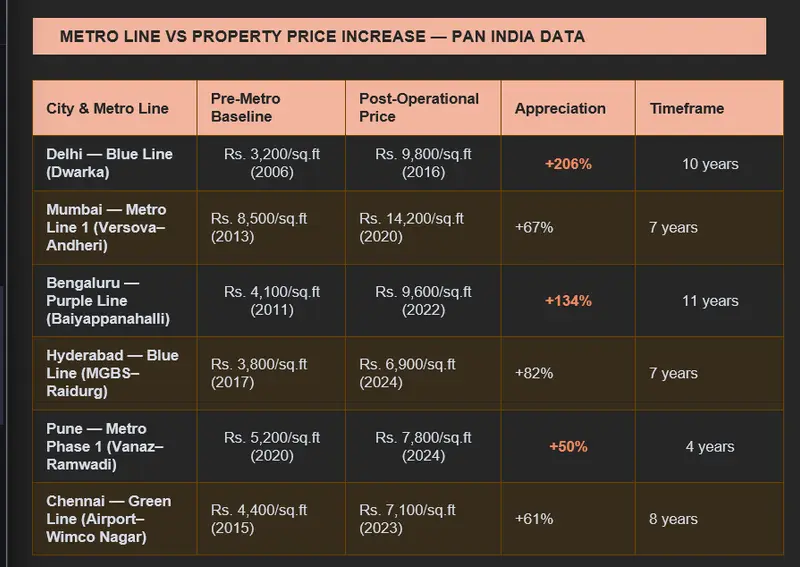
Metro-linked appreciation is well-documented across India's major cities. The data consistently supports a 20–45% premium for properties within 1 km of operational metro stations compared to city-wide averages — but the magnitude varies significantly by city, corridor, and station characteristics.
The Variables That Determine How Much a Metro Station Moves Prices
Not every metro station delivers equal appreciation. Understanding the variables that amplify or dampen the metro effect is the difference between a high-return entry and a mediocre one.
Distance from Station
The metro appreciation gradient is steep. Properties within 500 metres of a station consistently outperform those 500 to 1,000 metres away, which in turn outperform those at 1 to 2 kilometres. Beyond 2 kilometres, the measurable metro effect on residential prices diminishes to near zero in most Indian markets. The 500-metre walkable zone is the prime band — and it commands the highest premium both in terms of capital values and rental yields.
Station Type: Interchange vs. Terminal vs. Mid-Line
Interchange stations — where two or more metro lines cross — generate the highest appreciation because they offer access to multiple corridors and serve the widest catchment. Terminal stations attract commercial development and typically see strong rental demand. Mid-line stations in densely populated residential catchments can outperform interchange stations when the surrounding demographic density is high and competing supply is limited.
Phase of Project Execution at Entry
Entry timing relative to metro execution stage is the most controllable variable for investors. Buying at announcement captures the speculative upside but absorbs execution risk. Buying at tender award or visible construction — typically 2 to 4 years before commissioning — balances risk and return most effectively. Buying post-commissioning still captures appreciation from density growth and ongoing demand, but the first-mover premium has already been claimed.
Last Mile Quality
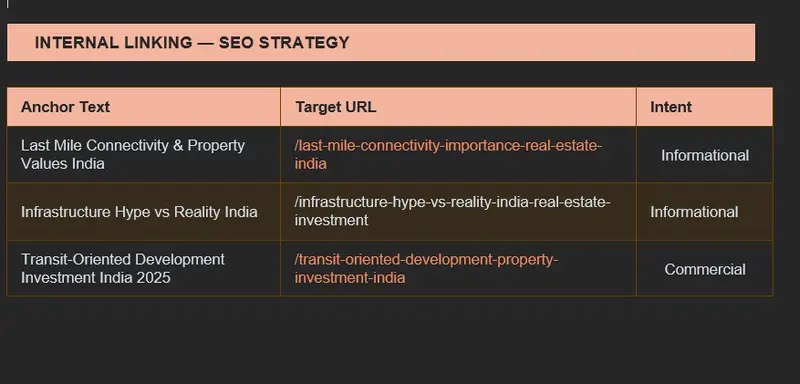
As established in Intel Realty's Last Mile Connectivity Guide, the quality of feeder infrastructure between a metro station and surrounding residential areas significantly amplifies or dampens the station's price effect. Stations with strong e-rickshaw, feeder bus, and walking infrastructure consistently outperform identical-distance stations with poor last mile access.
3 Case Studies: Metro Impact on Property Prices Across India
Case Study 1 — Delhi Metro Blue Line: Dwarka's Decade of Transformation
"I bought a 2BHK in Dwarka Sector 6 in 2005, one year before the Blue Line reached the area. My entry price was Rs. 24 Lakhs. By 2015, the same flat was valued at Rs. 82 Lakhs. Nothing changed about the flat — the metro changed everything about the location." — Long-term Investor, Dwarka, Delhi
Dwarka's transformation is the most comprehensively documented example of metro-driven residential appreciation in India. When the Delhi Metro Blue Line reached Dwarka Sector 21 in 2006, Dwarka was a well-planned but relatively illiquid residential area — large in area but poorly connected to Delhi's employment centres.
The metro changed the location's fundamental proposition. Residents could now reach Connaught Place in under 40 minutes and the airport in 20. Demand surged from working professionals who had previously avoided Dwarka due to commute times. Between 2006 and 2016, residential prices across Dwarka sectors within 800 metres of metro stations appreciated by 180 to 240%, compared to 95 to 120% appreciation in comparable non-metro-connected peripheral areas of Delhi over the same period.
The case demonstrates both the scale of metro-driven appreciation and its durability — the premium established in the decade following metro commissioning has been maintained and grown through subsequent market cycles.
Lesson: Metro connectivity established in a well-planned residential area creates durable, multi-cycle appreciation that compounds across decades, not just in the first post-commissioning years.
Case Study 2 — Hyderabad Metro: Corridor-by-Corridor Return Variation
"My advisor told me all metro stations are equal. They are not. I bought near HITEC City station and my appreciation in five years was 78%. My colleague bought near a station on the same line but in a lower-density zone — 31% over the same period. Station selection within the same metro network is a decision that matters." — Property Investor, Hyderabad
The Hyderabad Metro, operational since 2017, provides one of India's clearest examples of within-network appreciation variation. The three corridors — Red, Blue, and Green — serve very different catchments and have delivered significantly different property price outcomes despite operating on the same network.
The Blue Line's HITEC City and Raidurg stations, serving the technology employment hub, have delivered residential appreciation of 65 to 85% since commissioning. The Red Line's stations through older, lower-density residential areas have seen 25 to 40% appreciation over the same period. The differential is driven entirely by catchment demographics, employment density, and last mile quality — not by metro access itself.
For investors, the Hyderabad case demonstrates that station selection within a metro network requires the same rigour as city selection. The network label matters less than the specific station's employment catchment, residential density, and last mile infrastructure.
Lesson: Metro network membership is the starting point of analysis, not the conclusion. Station-level due diligence — catchment, employment proximity, density, last mile — determines actual return.
Case Study 3 — Bengaluru Metro Phase 2: The Pre-Commissioning Entry Opportunity
"Intel Realty identified the Bengaluru Metro Phase 2 Outer Ring Road corridor as an entry opportunity 18 months before commissioning. We bought at Rs. 5,800 per sq.ft. By the time the stations opened, the same properties were quoting Rs. 7,400. We entered on verified construction progress, not on the announcement." — Investor, Bengaluru
Bengaluru Metro Phase 2, which extended the network to key employment hubs including Whitefield and the Outer Ring Road technology corridor, was tracked by Intel Realty from the tender award stage. Once visible construction was confirmed at multiple station sites and civil work was progressing on schedule, we identified the pre-commissioning window as the optimal entry point for residential investors.
Properties within 800 metres of planned Phase 2 stations along the ORR tech corridor were still priced at 15 to 20% below post-commissioning expectations at the 18-month-to-opening mark. Buyers who entered during this window and held through commissioning captured the remaining pre-commissioning appreciation plus the immediate post-commissioning uplift — a combined gain of 25 to 35% in under two years.
The Bengaluru Phase 2 case illustrates the pre-commissioning entry strategy in action — entering after execution risk is substantially resolved but before the market has fully priced in the connectivity premium.
Lesson: The 12 to 24 months before a metro line opens is one of the most consistently rewarding entry windows in Indian real estate — risk is low, upside is real, and the market has not yet fully priced in the connectivity change.
How to Invest Smart Along Metro Corridors in India
Investing near metro corridors is not simply a matter of proximity. Here is the framework Intel Realty uses to evaluate every metro-linked investment opportunity across Indian cities:
Identify the execution stage: Confirm whether the metro project is at announcement, DPR, tender, construction, or commissioning stage. Each stage carries different risk and different residual upside.
Map the 500-metre zone: Focus on properties within 500 to 800 metres of the planned station for maximum appreciation exposure. Beyond 1 km, the metro premium diminishes sharply.
Assess station type: Interchange stations and employment-adjacent stations consistently outperform mid-line residential stations in appreciation magnitude. Prioritise accordingly.
Evaluate last mile quality: Confirm that feeder buses, e-rickshaw networks, and footpath infrastructure either exist or are planned. Metro proximity without last mile access delivers a fraction of the potential premium.
Check supply pipeline: High appreciation near metro stations can trigger a developer supply surge that dampens returns. Assess the approved and under-construction inventory within the 1 km catchment before committing.
Verify RERA registration: In corridors with high metro-linked demand, builder launches proliferate. Always verify RERA registration and construction progress independently before any booking.
Target pre-commissioning entry: The 12 to 18 months before metro commissioning consistently offer the best balance of execution certainty and residual price upside
FAQ: Metro Lines and Property Price Increases in India
Q1. How much do property prices increase near metro stations in India?
Based on Intel Realty's research across 14 metro corridors in 6 Indian cities, residential properties within 1 km of operational metro stations have appreciated an average of 31% more over five years than comparable properties more than 3 km from metro access. In high-demand corridors — such as Delhi's Blue Line Dwarka stretch or Bengaluru's ORR tech corridor — the premium can reach 80 to 120% over a decade. The magnitude depends on station type, last mile quality, catchment demographics, and the timing of the investment relative to metro commissioning.
Q2. When is the best time to buy property near a metro station?
The optimal entry window for metro-linked investment is 12 to 24 months before commissioning — after construction is visibly progressing and execution risk is substantially resolved, but before the market has fully priced in the connectivity change. Buying at announcement absorbs execution risk over multiple years. Buying post-commissioning still delivers appreciation from density growth, but the first-mover premium is already claimed. Pre-commissioning entry consistently offers the best balance of risk and return across Indian metro markets.
Q3. Are all metro stations equal in terms of property appreciation impact?
No. Station type, employment catchment, residential density, last mile quality, and competing supply all create significant variation in appreciation within the same metro network. Interchange stations and employment-adjacent stations consistently outperform mid-line residential stations. Hyderabad Metro's HITEC City station delivered 78% appreciation versus 31% at a comparable-distance station on the same network — the differential was driven entirely by station-level variables, not network membership.
Q4. Does the metro effect wear off over time?
No — in fact, the metro effect tends to compound over time as density increases, employment clusters grow around stations, and last mile infrastructure improves. Delhi's Blue Line stations, now 15 to 20 years operational, continue to outperform comparable non-metro locations in both capital appreciation and rental yields. The appreciation cycle has multiple phases: speculative premium at announcement, execution premium during construction, commissioning uplift on opening, and long-term density premium as the corridor matures.
Q5. How do I identify the best metro-adjacent property investment opportunities across India?
Focus on projects within 500 to 800 metres of planned or operational stations in corridors where metro execution is at Stage 4 (tender award) or Stage 5 (visible construction). Prioritise interchange or employment-adjacent stations over mid-line residential stations. Verify last mile infrastructure quality — feeder buses, e-rickshaw networks, and walkability. Assess the approved supply pipeline within 1 km to identify corridors where demand will outpace supply. Always verify RERA registration independently.