
LONG-TERM VS. SHORT-TERM PROPERTY INVESTMENT IN GURGAON: COMPLETE 2026 GUIDE
Introduction
Gurgaon's luxury real estate market in 2026 offers two distinct investment paths: long-term wealth building through appreciation and rental income, or short-term gains through market cycle timing. Neither approach suits every investor. Success requires matching your strategy to your capital, time commitment, and risk tolerance.
This guide compares both approaches, helping HNIs, investors, and NRIs select the strategy that aligns with their goals and market conditions.
Long-Term Investment Strategy
Buy-and-Hold Fundamentals
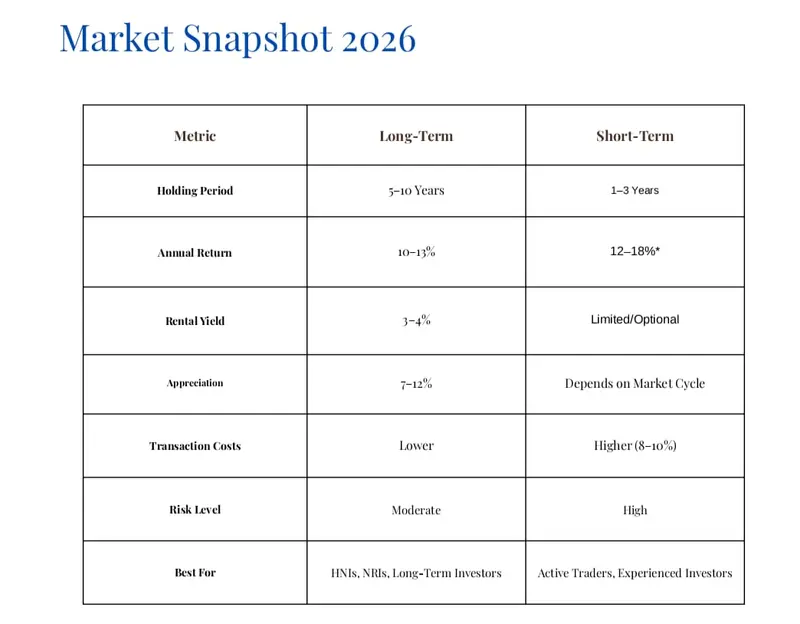
Long-term investors hold properties 5-10 years, capturing steady appreciation and rental income. Gurgaon's long-term investors achieve 7-9% annual appreciation combined with 3.0-4.0% rental yields—totaling 10-13% annually.
Established sectors (DLF Phase 5, Golf Course Extension Road) provide stable value retention and consistent rental demand. Emerging zones (Sector 109-110, Manesar Extension) offer higher appreciation potential at 9-12% annually for wealth-building timelines.
Core Advantages
Reduced transaction costs through single acquisition and exit. Rental income provides consistent cash flow while properties appreciate. Tax-advantaged capital gains after 2-year holding periods boost net returns. Minimal timing pressure allows market cycles to resolve naturally.
This strategy suits HNI families purchasing owner-occupied properties, investors generating retirement income, and NRIs seeking stable international investments.
Key Considerations
Capital lockup prevents deploying funds into other opportunities. Market corrections extend break-even timelines. Maintenance costs and property management require attention. Tenant-related challenges demand operational oversight.
Short-Term Investment Strategy
Flip-and-Exit Models
Short-term investors hold properties 1-3 years, targeting quick gains through phase pricing differentials or market cycle peaks. Early Phase 1 buyers purchasing at launch pricing can exit Phase 2 completion at 12-18% premiums over 18-24 months.
Realistic returns range 12-18% annually during favorable cycles. Emerging zones present opportunities for phase-based arbitrage; established sectors offer tactical peak-cycle exits.
Core Advantages
Quick capital recovery enables portfolio rotation and diversification. Minimal holding periods reduce maintenance obligations. Strong timing discipline captures peak-cycle premiums before corrections.
This approach suits active traders with market expertise, investors seeking portfolio rotation, and those capitalizing on project-specific pricing inefficiencies.
Key Challenges
Transaction costs (8-10% of property value) significantly impact net returns. Market timing proves difficult—missed exits can reverse profits into losses. Sale timelines extend 3-6 months, delaying capital recovery. Short-term capital gains face 20% LTCG taxation versus exempt long-term treatment.
Strategy Comparison
Timeline and Capital Deployment
Long-term strategies deploy capital upfront with 5-10 year holding periods. Short-term approaches require higher capital reserves for multiple simultaneous acquisitions and quicker transaction cycles.
Long-term suits single or dual property purchases; short-term benefits from portfolio volume absorbing transaction costs across multiple deals.
Income and Returns
Long-term strategies generate consistent rental yields (3.0-4.0% annually) alongside appreciation. Short-term traders typically avoid rentals, minimizing management overhead but forfeiting passive income.
Exit timing determines short-term success—missing 3-month market windows can reduce returns by 8-12%. Long-term investors sidestep this pressure through extended holding periods.
Rental Income Dynamics
Emerging zone properties yield 3.2-3.8% annually; established sectors yield 2.5-3.0%. Long-term holders capitalize on this income throughout ownership. Short-term investors occasionally use temporary rentals to offset carrying costs during holding periods.
Market Snapshot 2026
Investment Tips
Assess Your Profile
Evaluate capital availability, risk tolerance, and time commitment. HNI families purchasing owner-occupied properties naturally favor long-term holds. Active traders with market expertise suit short-term strategies. NRIs seeking stability prefer long-term approaches.
Analyze Current Market Position
Early growth cycles favor emerging zone long-term purchases. Peak valuation periods suit tactical short-term exits. Market corrections present long-term accumulation opportunities.
Gurgaon's 2026 positioning suggests balanced opportunities—emerging zones favor long-term buyers while established sectors offer short-term tactical plays.
Evaluate Zone-Specific Dynamics
Emerging zones (Sector 109-110, Manesar Extension) offer 9-12% annual appreciation suits long-term investors. Established sectors provide rental stability and shorter sale timelines benefiting short-term traders.
Match your strategy to zone characteristics and current market phase.
Conclusion
Long-term and short-term property investment strategies both deliver returns
urns through appreciation and rental income, suiting patient wealth builders. Short-term strategies target 12-18% returns during favorable cycles, requiring market timing expertise.
The optimal choice depends on your capital position, risk tolerance, and market outlook. Conservative investors benefit from long-term emerging zone purchases. Active traders leverage cycle timing for concentrated short-term gains.
Determine your investment profile today. Connect with specialists who align strategies with your goals, positioning you for maximum portfolio returns in Gurgaon's luxury real estate market.
FREQUENTLY ASKED QUESTIONS
Q: Which strategy generates higher total returns?
A: Long-term strategies average 10-13% annually when combining 7-9% appreciation with 3.0-4.0% rental yields. Short-term strategies target 12-18% during favorable cycles but risk negative returns during downturns. Risk-adjusted, long-term approaches often deliver superior wealth creation over 10-year periods.
Q: What's the ideal minimum holding period for short-term plays?
A: 18-24 months provide realistic exit windows. Phase transitions typically occur 18 months post-launch, establishing new pricing benchmarks. Earlier exits face transaction cost headwinds; longer holds reduce annualized returns.
Q: Do emerging zones suit long-term or short-term investment?
A: Emerging zones suit long-term investors capturing 9-12% annual appreciation as infrastructure matures. Short-term traders target phase-pricing differentials but face higher execution risk if market sentiment shifts.
Q: How do rental yields affect strategy selection?
A: Rental income strengthens long-term strategy returns through passive cash flow while appreciation compounds. Short-term traders typically bypass rentals. In 2026, emerging zone yields of 3.2-3.8% significantly enhance long-term total returns.
Q: What's the tax impact of each strategy?
A: Long-term holdings (2+ years) qualify for exempt capital gains taxation. Short-term holdings face 20% LTCG taxation on gains, reducing net proceeds. This tax differential substantially amplifies long-term strategy advantages.
Q: Which investor profile suits each strategy best?
A: Long-term suits HNI families purchasing owner-occupied properties, retirement planners generating passive income, and NRIs seeking stable investments. Short-term suits active traders with market expertise, portfolio rotators, and investors capitalizing on project-specific inefficiencies.