Aggregation vs. Direct Purchase: Land Acquisition Strategies for Developers in Gurgaon
Introduction
Developers in Gurgaon face critical acquisition strategy decisions: pursue aggregation combining multiple small parcels or execute direct large-site purchases. Each approach offers distinct advantages and operational complexity. Understanding these alternatives determines project viability and timeline feasibility.
Gurgaon's fragmented land ownership patterns create acquisition challenges. Small farmers and individual landowners control most available parcels. Developers assembling large developable sites must aggregate multiple ownerships through complex negotiations spanning 12-24 months. Direct large-parcel purchases compress timelines but command premium valuations. This comprehensive guide examines both strategies, revealing optimal approaches for various developer scenarios in 2026.
Understanding Land Aggregation Mechanics
Land aggregation combines multiple small land parcels from individual owners into consolidated development sites. This strategy addresses Gurgaon's fragmented ownership pattern while optimizing acquisition economics.
Aggregation Process & Timeline
Developers identify clusters of small parcels meeting development criteria through systematic site surveys. Experienced aggregators maintain databases of 20-30 target parcels comprising potential 5-10 acre development sites. Negotiation with individual landowners spans 12-18 months as farmers evaluate offers against alternative uses.
Aggregation success requires persistent relationship-building. Landowners harbor skepticism toward developers following previous unfulfilled promises or disputes. Patient negotiators earning owner trust achieve smoother transactions with reduced litigation risk.
Aggregation Cost Advantages
Individual landowners often underestimate market value, accepting 10-20% discounts to guaranteed sales. A parcel trading at INR 5,000 per sqft in direct market purchase averages INR 4,000-4,500 per sqft when aggregated through patient negotiation. This 10-20% discount on total acquisition cost (typically 25-30% of project economics) translates to INR 15-40 lakhs savings per acre.
Volume aggregation enables developers to absorb transaction costs across multiple parcels. Legal documentation, title verification, and survey expenses amortize efficiently across larger portfolios.
Aggregation Operational Complexity
Managing 15-25 individual landowner transactions creates administrative burden. Title disputes, encumbrance resolution, and consent documentation demand meticulous process management. Single problematic owner can delay entire project 6-12 months if unresolved.
Aggregation requires specialized legal and administrative expertise. Developers employing dedicated aggregation teams reduce per-parcel transaction cost while maintaining timeline discipline.
Understanding Direct Purchase Strategy
Direct large-parcel purchases involve acquiring consolidated sites from single owners, aggregators, or institutional entities. This approach emphasizes timeline compression over acquisition cost optimization.
Direct Purchase Timeline Advantage
Acquiring single large parcels compresses acquisition timelines 6-12 months versus aggregation. Developers securing 8-10 acre consolidated sites from institutional owners complete acquisitions within 4-6 months. This timeline compression expedites project launches capturing favorable market windows.
A developer launching 18 months earlier captures market demand appreciation offsetting 10-15% higher land cost. Market timing advantage often exceeds acquisition cost differential.
Direct Purchase Cost Premium
Consolidated sites command 10-20% acquisition premiums compared to aggregated land. Institutions selling large parcels extract maximum value knowing buyer alternatives limited. Direct purchase of 8 acres at INR 6,000 per sqft versus aggregated site at INR 4,800 per sqft represents 25% cost differential.
Premium valuations reflect time value advantage and reduced transaction complexity. Developers unable to bear acquisition premiums must pursue aggregation.
Regulatory & Approval Advantages
Large consolidated sites benefit from streamlined approvals versus fragmented parcels. Municipal authorities prefer single development projects over multiple small applications. Environmental clearances proceed faster with unified sites. Direct purchase sites average 30-45 day approval timeline reduction.
Why Emerging Corridors Favor Aggregation Strategy
Gurgaon's expanding zones maintain fragmented ownership patterns favoring aggregation economics.
Sector 43 & Sector 52 Aggregation Opportunity
Emerging zones like Sector 43 remain largely agricultural with individual small-holder ownership. Landowners in these zones accept 15-25% discounts seeking assured sales. Aggregation economics here deliver exceptional savings. A 5-acre project assembled at INR 3,500-4,000 per sqft through aggregation versus direct purchase at INR 4,500-5,200 per sqft represents INR 30-50 lakhs per acre advantage.
Infrastructure Development Timeline
Developers aggregating land before infrastructure development (metro extensions, highway completion) capture appreciation as infrastructure emerges. Land assembled at INR 3,000-3,500 per sqft appreciates to INR 4,500-5,000 as infrastructure catalysts materialize within 18-24 months. This appreciation amortizes aggregation transaction costs while rewarding patient capita
Volume Incentives
Agricultural landowners facing market saturation accept bulk sale discounts. A farmer with 1-acre parcel may accept 5-8% discount for direct sale. Aggregators purchasing 10-15 acre clusters negotiate 15-25% reductions. This volume incentive rewards patient, systematic aggregation.
Key Indicators of Successful Aggregation vs. Direct Purchase
Strategic developers evaluate project circumstances determining optimal acquisition approach.
Timeline Criticality Assessment
Projects requiring market window capture (pre-competitive launches, seasonal demand peaks) demand direct purchase despite premium valuations. Developers with timeline flexibility benefit from aggregation cost economics. Evaluate market timing value against acquisition cost differential.
Capital Availability & Financing Structure
Aggregation requires 18-24 month capital deployment with gradual parcel purchases. Developers with patient capital structures benefit from aggregation economics. Direct purchase requires concentrated capital deployment favoring firms with institutional funding.
Operational Capacity Evaluation
Successful aggregation demands dedicated team managing 15-25 individual transactions simultaneously. Developers lacking aggregation expertise struggle managing complexity. Firms with proven aggregation track records capture 10-20% cost advantages justifying strategy investment.
Regulatory & Title Complexity
Sites with clear titles and minimal encumbrances favor direct purchase reducing approval risk. Fragmented sites requiring title consolidation justify aggregation timeline investment capturing cost savings.
Top Gurgaon Acquisition Corridors & Strategic Recommendations
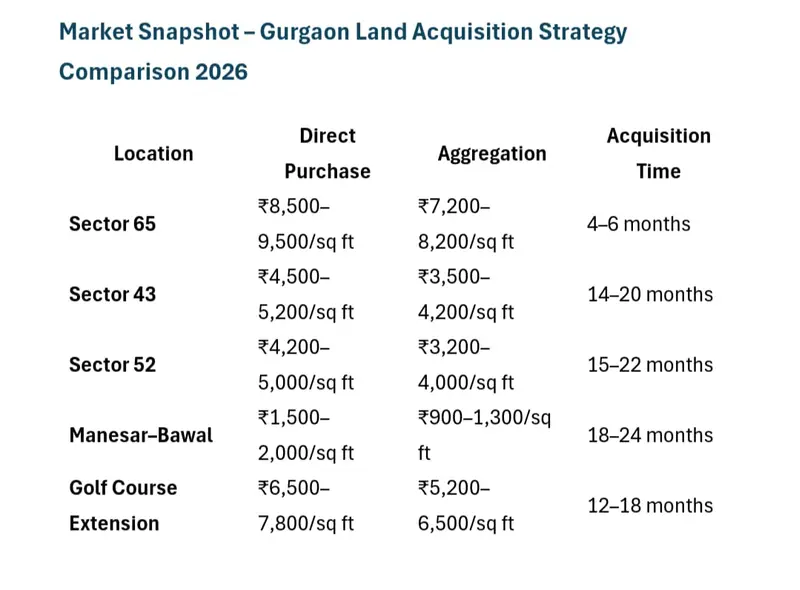
Sector 65 – Direct purchase preferred, Consolidated site availability, INR 7,500-9,000 per sqft
Sector 43 – Aggregation optimal, Agricultural fragmentation, INR 3,000-4,000 per sqft aggregated vs. 4,000-4,800 direct
Sector 52 – Aggregation favorable, Emerging development zone, INR 3,500-4,500 per sqft aggregated valuation
Manesar-Bawal Corridor – Aggregation highly favorable, Maximum discounts, INR 800-1,200 per sqft aggregated acquisition
Golf Course Road Extension – Direct purchase recommended, Limited large site availability, INR 5,500-7,000 per sqft
Market Snapshot – Gurgaon Land Acquisition Strategy Comparison 2026
Strategic Acquisition Optimization Tips
Hybrid Acquisition Model
Sophisticated developers employ hybrid strategies combining aggregation and direct purchase. Acquire core 4-5 acres directly for rapid development launch while aggregating peripheral parcels for future expansion. This approach captures timeline advantage while pursuing long-term cost optimization.
Landowner Database Development
Maintain systematic landowner databases identifying potential parcels and owner contact information. Early engagement with farmers during pre-development phases builds relationships for future aggregation. Patience cultivating relationships yields 15-20% cost advantages versus rushed negotiations.
Regulatory Liaison Management
Early coordination with municipal authorities streamlines approval processes for both strategies. Developers maintaining municipal relationships receive expedited guidance. This relationship capital proves equally valuable for aggregated and directly-purchased sites.
Title Verification Protocols
Implement rigorous title examination during acquisition evaluation. Parcels requiring extended remediation consume savings from acquisition cost advantages. Invest in professional title surveys identifying potential issues before commitment.
Financing Structure Optimization
Structure land acquisition financing to match cash flow timelines. Aggregation benefits from staged payment arrangements spreading capital deployment. Direct purchase often requires concentrated capital. Match financing approach to acquisition strategy.
Conclusion: Selecting Optimal Acquisition Strategy
Land aggregation and direct purchase each offer distinct advantages. Aggregation delivers 10-20% cost savings through patient negotiation and volume incentives—optimal for emerging zones like Sector 43 and timeline-flexible developers. Direct purchase compresses timelines 6-12 months enabling market window capture—valuable for competitive launches despite premium acquisition costs.
Strategic developers evaluate project timelines, capital availability, and operational capacity determining optimal approach. Emerging corridors with fragmented ownership favor aggregation capturing exceptional savings. Established premium zones with consolidated sites justify direct purchase for rapid execution. Hybrid strategies combining both approaches balance cost and timeline optimization.
Ready to optimize your land acquisition strategy? Connect with our acquisition specialists to evaluate aggregation vs. direct purchase for your Gurgaon project.
Frequently Asked Questions
Q1: What cost savings can developers achieve through land aggregation in Gurgaon?
Aggregation delivers 10-20% cost savings through landowner discounts and patient negotiation. A 5-acre project assembled at INR 3,500-4,000 per sqft through aggregation versus direct purchase at INR 4,500-5,200 represents INR 30-50 lakhs per acre advantage. Emerging zones like Sector 43 maximize aggregation benefits through higher fragmentation.
Q2: How long does land aggregation typically take in Gurgaon?
Land aggregation timelines span 14-24 months depending on parcel count, owner willingness, and regulatory complexity. Systematic aggregators maintaining organized databases expedite timelines to 12-18 months. Direct purchase compresses timelines to 4-6 months for consolidated sites, justifying premium valuations for timeline-critical projects.
Q3: Which Gurgaon locations favor aggregation over direct purchase?
Emerging zones like Sector 43, Sector 52, and Manesar-Bawal corridor favor aggregation due to fragmented agricultural ownership. Developers here achieve 15-25% cost discounts through patient negotiation. Premium established zones like Sector 65 offer consolidated direct purchase opportunities commanding 8,500-9,500 per sqft premiums offsetting reduced acquisition timelines.
Q4: How do developers mitigate aggregation risks like title disputes?
Implement rigorous title verification through professional surveys identifying potential encumbrances. Conduct early owner engagement building trust and transparency. Maintain dedicated legal teams managing documentation ensuring compliance. Establish escrow arrangements protecting against title defects. Professional aggregation reduces dispute risk 30-40% versus ad-hoc approaches.
Q5: What financing structures optimize aggregation strategies?
Structure land acquisition financing with staged payments matching owner agreements. Developers can arrange 50% upfront with remaining payments at possession. This structure requires patient capital deployment spanning 18-24 months. Direct purchase typically demands concentrated capital at signing. Financing flexibility critical for aggregation success.
Q6: Should developers pursue aggregation in premium zones like Sector 65?
Premium zones typically feature consolidated large-site ownership favoring direct purchase. Direct purchase here compresses timelines capturing market demand premium offsetting 10-15% higher acquisition costs. Aggregation in premium zones rarely delivers sufficient cost savings justifying 6-12 month timeline extension. Reserve aggregation strategy for emerging, fragmented zones.