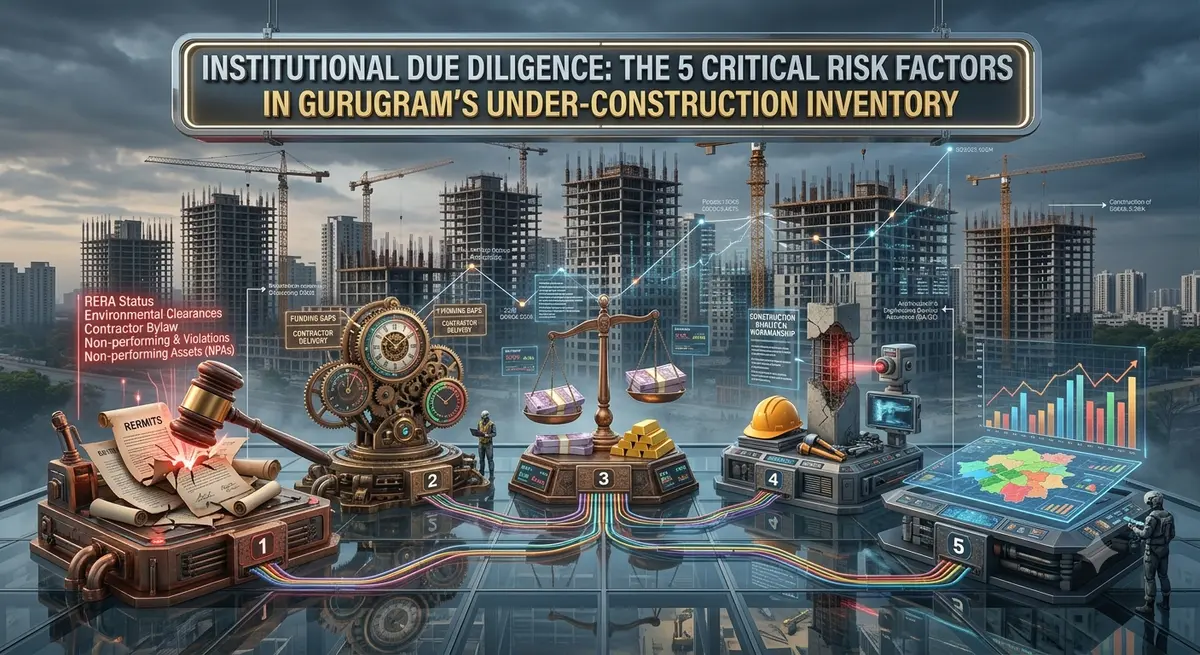
5 Risks of Buying Under Construction Property in Gurgaon
Institutional Due Diligence: 5 Critical Risks of Buying Under Construction Property in Gurgaon
The Gurugram real estate market is witnessing unprecedented growth in 2026, driven by infrastructure upgrades like the Dwarka Expressway, Golf Course Extension Road, and upcoming metro corridors. For homebuyers, NRIs, and investors, buying under construction property in Gurgaon offers attractive price appreciation, flexible payment plans, and the ability to customize interiors.
However, high rewards come with significant risks. While the Real Estate (Regulation and Development) Act (RERA) has introduced stringent compliance measures, the market still demands institutional-level due diligence to protect your capital. Relying solely on glossy brochures and sales pitches can lead to locked funds, delayed timelines, or legal disputes.
To secure your investment, you must evaluate a project like an institutional investor. Here is a deep dive into the five critical risk factors in Gurgaon’s under-construction inventory and how to navigate them.
Why Advanced Due Diligence is Non-Negotiable in Gurugram
Gurgaon's real estate ecosystem is complex. Properties range from high-rise luxury condominiums to builder floors in licensed colonies. A single compliance failure by the developer can stall a project for years. Conducting thorough due diligence ensures that the developer has clear land titles, legal authority to build, and the financial health to deliver the project on time.
The 5 Critical Risk Factors in Gurgaon's Under Construction Inventory
1. Title Ambiguity and Land Use Violations
The foundation of a safe real estate investment is a clear, unencumbered land title. In Gurgaon, agricultural land is rapidly being converted for residential and commercial use, creating potential loopholes in land acquisition and zoning compliance.If a developer builds a residential complex on land zoned for commercial or agricultural use without the proper Change of Land Use (CLU) approvals, the project risks demolition or severe litigation.
How to mitigate this risk:
Trace the Chain of Title: Ensure the chain of ownership is clear for the last 20 to 30 years.
Verify Haryana Land Records: Check the Jamabandi Nakal to verify the Khewat (owner details) and Khasra (land parcel) numbers.
Obtain an Encumbrance Certificate (EC): This document from the Sub-Registrar’s office confirms that the land is free from active mortgages, undisclosed loans, or pending court disputes.
2. Lack of HRERA Compliance and Illegal Pre-Launches
Investing in "pre-launch" or "soft-launch" projects that are not yet registered with the Haryana Real Estate Regulatory Authority (HRERA) is illegal and highly dangerous. Unregistered projects offer zero buyer protection, and developers cannot legally market them or collect booking amounts.
How to mitigate this risk:
Verify the HRERA Number: Always cross-check the project’s RERA registration number on the official HRERA Gurugram portal.
Check the Escrow Account: Under RERA guidelines, developers must deposit 70% of buyer payments into a dedicated project escrow account. This prevents the diversion of funds to other projects—a historically common reason for stalled developments in the NCR region.
Verify the Agent: Ensure your real estate consultant also possesses a valid HRERA agent registration number.
3. Construction Delays and Developer Solvency
Despite regulatory frameworks, construction delays remain the primary anxiety for buyers of under-construction projects. Developers may face liquidity crunches, labor shortages, or delays in procuring raw materials. Prolonged delays force buyers to bear the double financial burden of paying rent alongside home loan EMIs. Developers frequently cite force majeure (acts of God) to excuse delays, but authorities like HRERA strictly scrutinize these claims, often ruling that routine labor shortages or pollution-related construction bans do not justify indefinite delays.
How to mitigate this risk:
Audit Builder Credibility:Research the developer’s track record of delivery in Gurgaon over the last decade.
Understand Section 18 of RERA: If possession is delayed beyond the date specified in the agreement, you have the right to either withdraw and claim a full refund with interest, or stay invested and receive monthly interest compensation.
Check Bank Approvals: Ensure major national banks have approved the project for home loans. Banks conduct their own rigorous financial due diligence before approving a project.
4. Unfair Builder-Buyer Agreements (BBA)
The Builder-Buyer Agreement (BBA) is the legally binding contract dictating your purchase. Before RERA, these agreements were notoriously one-sided, heavily penalizing buyers for delayed payments while offering negligible penalties for delayed possession.
Buyers often face hidden costs not disclosed during the initial sales pitch, such as excessive Preferential Location Charges (PLC), inflated maintenance deposits, or unexpected GST burdens.
How to mitigate this risk:
Strictly Enforce the 10% Rule: RERA mandates that a builder cannot demand more than a 10% booking amount before the official BBA is signed and registered.
Verify Carpet Area Metrics: Ensure pricing is strictly based on the RERA-defined "Carpet Area," not ambiguous terms like "Super Built-Up Area".
Legal Review: Have a specialized property lawyer review the BBA for exit clauses, delay penalties, and hidden financial obligations.
5. Quality Deviations and Missing Amenities
What you see in the glossy brochure or the sample flat is not always what you get. A critical risk in under-construction properties is the dilution of construction quality, substitution with cheaper materials, or the non-delivery of promised amenities like clubhouses, swimming pools, and green spaces.
How to mitigate this risk:
Conduct Regular Site Visits: Do not rely solely on email updates. Physically visit the site to inspect the pace and quality of construction.
Leverage the 5-Year Defect Liability: Under RERA, developers are legally obligated to rectify any structural defects or poor workmanship reported within five years of possession, at no extra charge to the buyer.
Document Everything: Keep a written record (emails, registered letters) of all promises made by the sales team, as verbal commitments hold no legal weight.
Expert Due Diligence Checklist for Gurgaon Property Buyers
Before issuing that first cheque, complete this institutional-grade checklist:
1. Legal Check: Obtain the EC, Jamabandi Nakal, and verify the chain of title.
2. Regulatory Check: Confirm active HRERA registration, land-use approvals, and environmental clearances.
3. Financial Check: Ensure the 70% Escrow mechanism is active and verify major bank loan approvals.
4. Contractual Check: Have a lawyer vet the BBA for balanced penalty clauses and strict carpet-area pricing.
5. Physical Check: Schedule quarterly site visits to track construction milestones against the promised timeline.
FAQ Section
1. Is it safe to buy under-construction property in Gurgaon in 2026?
Yes, provided the project is registered with HRERA, developed by a reputed builder, and has clear land titles. RERA regulations have heavily minimized risks like fund diversion and indefinite delays by enforcing the 70% escrow rule and mandatory delay compensation.
2. How do I check if a Gurgaon project is RERA registered?
Visit the official HRERA Gurugram website. You can search the developer’s name or the project name to verify the registration number, view the approved layout plans, check litigation status, and track quarterly construction progress.
3. What happens if the builder delays possession in Haryana?
Under Section 18 of RERA, if a builder fails to deliver the property by the date specified in the Builder-Buyer Agreement, the buyer has two choices: claim a full refund with interest or stay invested and demand monthly interest compensation for the delay period.
4. Should I invest in an unregistered "pre-launch" project to get a better price?
Absolutely not. It is illegal for developers in Gurgaon to advertise, sell, or collect booking amounts for any project without HRERA registration. Investing in such projects strips you of all legal protections and exposes your capital to total loss.
5. What is the maximum booking amount a builder can ask for upfront?
According to RERA regulations, a developer cannot demand more than 10% of the total property cost as an advance or booking amount before signing and registering a formal Builder-Buyer Agreement.
6. Which is a better investment in Gurugram: Ready-to-move or under-construction?
It depends on your goals. Under-construction properties offer higher capital appreciation and flexible payment plans, making them ideal for long-term investors. Ready-to-move (RTM) properties carry zero construction risk and offer immediate rental yield, suiting end-users and risk-averse investors.