Gurgaon Property Market Cycle Explained
Gurgaon Property Market Cycle Explained
The real estate market does not move in a straight line. Like most investment sectors, it goes through different phases of growth, correction, recovery, and expansion. Gurgaon is no exception. Over the years, the city has experienced multiple market cycles influenced by infrastructure development, economic conditions, buyer demand, government policies, and corporate expansion.
Understanding the Gurgaon property market cycle can help homebuyers and investors make informed decisions about when to buy, hold, or sell property.
What Is a Property Market Cycle?
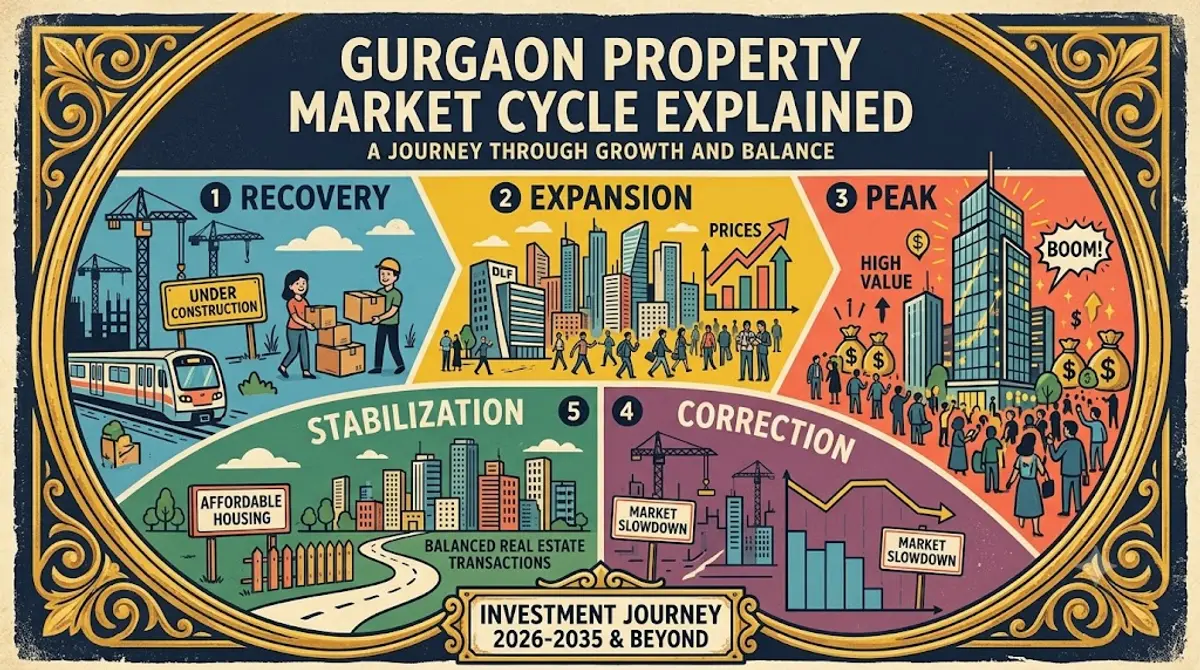
A property market cycle refers to the recurring pattern through which real estate prices and demand change over time. The cycle is typically divided into four stages:
- Recovery
- Expansion
- Peak
- Correction
Each phase presents different opportunities and challenges for buyers, sellers, and investors.
Recovery Phase
The recovery phase begins after a market slowdown or correction. Property prices stabilize, buyer confidence gradually returns, and developers restart new projects.
During this stage, inventory levels may still be high, allowing buyers to negotiate favorable prices. Long-term investors often consider recovery periods attractive because they can enter the market before significant appreciation begins.
Expansion Phase
As economic activity improves and demand increases, the market enters the expansion phase. Sales volumes rise, new project launches increase, and property prices begin appreciating steadily.
In Gurgaon, expansion is often supported by infrastructure projects, metro connectivity, corporate hiring, and increasing migration of professionals.
Rental demand also tends to strengthen during this period, benefiting buy-to-let investors.
Peak Phase
The peak phase is characterized by high buyer confidence, strong demand, and elevated property prices. Developers launch multiple projects, and investor activity reaches high levels.
While appreciation may continue, price growth usually slows compared to earlier stages as affordability becomes a concern. Buyers should carefully evaluate valuations before investing during this phase.
Correction Phase
A correction occurs when demand slows or supply exceeds market absorption. Property prices may stabilize or experience moderate declines, and sales activity can decrease temporarily.
Corrections are a natural part of market cycles and often create opportunities for long-term investors to purchase quality assets at relatively favorable prices.
Factors Influencing Gurgaon’s Property Cycle
Several factors shape the city's real estate cycle:
Infrastructure Development
Projects such as the Dwarka Expressway, metro expansion, and new road networks improve connectivity and often stimulate demand in surrounding sectors.
Corporate Expansion
The growth of multinational companies, IT firms, and Global Capability Centres increases employment opportunities, driving residential and commercial property demand.
Government Policies
Regulatory measures such as RERA, taxation changes, interest rate movements, and housing policies can influence buyer sentiment and investment decisions.
Economic Conditions
Income growth, inflation, financing costs, and broader economic performance affect affordability and purchasing power across the property market.
Supply and Demand Balance
The number of new project launches relative to buyer demand plays a critical role in determining price movements and market stability.
Gurgaon’s Historical Market Evolution
Over the past two decades, Gurgaon has transformed from a suburban extension of Delhi into one of India's leading business and residential hubs.
Early infrastructure development and corporate expansion led to rapid appreciation in many areas. Certain periods witnessed slower growth due to oversupply or broader economic factors, followed by renewed momentum as connectivity improved and demand recovered.
This demonstrates how property markets naturally move through different phases over time.
How Investors Can Benefit
Understanding market cycles allows investors to make more strategic decisions.
- Buying during recovery phases may provide greater appreciation potential.
- Investing during expansion can generate both rental income and capital gains.
- Exercising caution during peak periods helps avoid overpaying.
- Market corrections may create opportunities to acquire premium assets at more reasonable valuations.
A long-term investment perspective often helps reduce the impact of short-term market fluctuations.
What Homebuyers Should Know
End-users purchasing a home for personal use should focus primarily on affordability, location, lifestyle needs, and financial stability rather than attempting to perfectly time the market.
If the property meets long-term requirements and fits within the budget, short-term market cycles may have limited practical impact.
Future Outlook
Gurgaon’s long-term outlook remains supported by infrastructure investment, corporate growth, premium residential demand, and continued urban expansion.
While future price movements cannot be predicted with certainty, understanding market cycles can help investors and buyers make more balanced decisions and avoid emotional reactions to temporary fluctuations.
Common Mistakes to Avoid
Many buyers make investment decisions based solely on recent price increases or market hype.
Instead, it is important to evaluate:
- Location quality
- Connectivity
- Developer reputation
- Rental demand
- Legal approvals
- Future infrastructure plans
- Long-term holding potential
These factors often have a greater influence on investment success than short-term market timing.
Conclusion
The Gurgaon property market cycle reflects the natural evolution of supply, demand, economic conditions, and infrastructure development. By recognizing the stages of recovery, expansion, peak, and correction, investors and homebuyers can make more informed and strategic decisions.
Rather than chasing short-term trends, focusing on quality assets and long-term fundamentals remains one of the most effective approaches to building value in Gurgaon’s dynamic real estate market.
Frequently Asked Questions (FAQs)
1. What is the Gurgaon property market cycle?
It is the recurring pattern of recovery, expansion, peak, and correction through which Gurgaon’s real estate market evolves over time.
2. Which phase is generally considered best for investment?
Many long-term investors prefer the recovery or early expansion phase because prices may be relatively attractive while future appreciation potential remains strong.
3. What factors affect Gurgaon’s property market cycle?
Infrastructure development, corporate growth, government policies, interest rates, economic conditions, and supply-demand dynamics all influence the market cycle.
4. Should homebuyers wait for a market correction?
Not necessarily. End-users should prioritize affordability, personal needs, and long-term financial planning rather than trying to perfectly time the market.