
Gurgaon vs Mumbai: Why ₹10 Crore+ Properties Deliver Better ROI for Investors
Introduction
For decades, Mumbai held an unquestioned monopoly on India's ultra-luxury real estate market. Premium addresses along the Arabian Sea commanded premium valuations, attracting the nation's wealthiest investors and homebuyers. However, a significant structural shift is reshaping investment decisions for high-net-worth individuals (HNWIs), Non-Resident Indians (NRIs), and seasoned portfolio investors.
Gurgaon's ultra-luxury housing segment—properties priced at ₹10 crore and above—has witnessed a remarkable 145% growth over recent years. This isn't a temporary market blip. It represents a fundamental reordering of investment preferences driven by superior returns, modern infrastructure, and changing lifestyle priorities.
For investors evaluating where to deploy capital in India's premium residential sector, the data now points to a clear winner. This analysis examines why Gurgaon's luxury properties deliver superior ROI compared to Mumbai's established ultra-premium markets, and what this means for your investment strategy.
Why Gurgaon Has Become the Preferred Luxury Investment Destination
The shift from Mumbai to Gurgaon isn't about market sentiment alone. It's grounded in measurable economic fundamentals and tangible infrastructure advantages.
Mumbai's ultra-luxury market has matured significantly. Prime locations like Worli, Malabar Hill, and Bandra command established price points with limited upside potential. Properties in these markets trade at significant premiums—often ₹5 to ₹10 lakh per square foot—leaving little room for capital appreciation. While rental yields exist, they remain constrained by limited inventory and high entry costs.
Gurgaon presents a contrasting investment thesis. The city has witnessed explosive wealth creation through its thriving startup ecosystem, multinational corporate presence, and global professional workforce. This demand base continues expanding, supporting sustained appreciation in premium properties.
More importantly, Gurgaon's luxury market remains in a growth phase. Prime corridors like Golf Course Road, Golf Course Extension Road, and Dwarka Expressway offer meaningful appreciation potential as infrastructure improves and corporate expansion accelerates. Investors entering these markets today benefit from capital gains that appreciated properties in Mumbai no longer provide
The Capital Appreciation Advantage: Gurgaon's Superior Returns
Recent market data reveals the mathematical case for Gurgaon luxury investments. Properties in established premium micro-markets have appreciated at 12-18% annually over the past five years. This far exceeds Mumbai's ultra-luxury segment, where appreciation typically ranges from 6-10% annually.
Several factors drive this superior appreciation trajectory. First, Gurgaon's limited ultra-luxury inventory creates demand-supply imbalances that favor appreciation. New supply in the ₹10 crore+ segment launches gradually and exclusively in premium locations. This scarcity directly translates to price appreciation.
Second, infrastructure investments continue enhancing property values. The Dwarka Expressway, Southern Peripheral Road (SPR), Metro expansion, and improved connectivity to Delhi Airport systematically strengthen micro-markets along these corridors. Investors who purchased properties before infrastructure completion benefit significantly as connectivity improves and property desirability increases.
Third, the buyer base for ₹10 crore+ properties remains concentrated among high-income professionals, entrepreneurs, and HNWIs. As India's wealth creation accelerates—particularly in technology, financial services, and manufacturing—demand from these segments continues rising. This growing affluent population sustains upward pressure on luxury property prices.
Mumbai's mature market operates differently. Most infrastructure improvements have already occurred. Property appreciation depends primarily on scarcity and demand shifts rather than infrastructure-led value creation. This constrains long-term return potential for new investors.
Rental Yield Comparison: The Income Generation Story
While capital appreciation attracts attention, rental income matters significantly for investors seeking portfolio diversification and cash flow.
Gurgaon's premium residential market increasingly attracts high-income international tenants—expatriates working for multinational corporations, business professionals, and global executives. These tenants actively seek spacious, modern homes with premium amenities in developments offering international-standard living.
Premium projects in Gurgaon's established corridors command rental rates of ₹4-6 lakh monthly for ₹10 crore+ properties. This translates to gross rental yields of 4.8-7.2% annually—compelling returns for income-focused investors.
Mumbai's established ultra-luxury markets yield lower rental income relative to property values. Many ultra-premium buyers view these properties as wealth preservation assets rather than income generators. Rental demand exists, but valuations have outpaced rent growth, compressing yields below 4% in many prime locations.
For investors prioritizing cash flow alongside appreciation, Gurgaon's rental yield advantage becomes a significant consideration. Properties deliver both annual appreciation and meaningful monthly income—a dual return profile that Mumbai's ultra-luxury segment no longer provides.
Infrastructure-Driven Appreciation: The Multiplier Effect
Gurgaon's investment case rests fundamentally on infrastructure transformation. This point deserves emphasis because it differentiates the city's investment thesis from Mumbai's mature market dynamics.
The Dwarka Expressway represents the most significant infrastructure catalyst. Once fully operational, it reduces travel times to South Delhi and central business districts dramatically. Properties along this corridor—particularly in emerging luxury hotspots like New Gurgaon—benefit from connectivity improvements that drive both demand and valuations.
Gurgaon's investment case rests fundamentally on infrastructure transformation. This point deserves emphasis because it differentiates the city's investment thesis from Mumbai's mature market dynamics.
The Dwarka Expressway represents the most significant infrastructure catalyst. Once fully operational, it reduces travel times to South Delhi and central business districts dramatically. Properties along this corridor—particularly in emerging luxury hotspots like New Gurgaon—benefit from connectivity improvements that drive both demand and valuations.
The Buyer Profile Evolution: Growing Demand from HNWIs and Entrepreneurs
Mumbai's ultra-luxury market attracts a broad mix of investors—traditional business families, financial investors, and international buyers. Gurgaon's emerging ultra-luxury segment attracts a more concentrated, high-growth demographic.
The city's thriving startup ecosystem and multinational corporate presence create unprecedented wealth among entrepreneurs, technology founders, and senior executives. These high-income professionals prioritize lifestyle factors—spacious homes, premium amenities, wellness facilities, smart home technology—alongside investment returns. They actively choose Gurgaon because the city aligns with their professional base and lifestyle preferences.
This concentrated buyer base from high-growth sectors creates sustained demand. As the startup ecosystem matures and multinational presence expands, demand from this segment continues rising. This differentiates Gurgaon from Mumbai, where buyer demand reflects broader wealth categories without sector-specific concentration.
For investors, this matters significantly. The buyer base driving appreciation in Gurgaon luxury properties remains in high-growth professions with strong income generation. This supports sustained demand and appreciation. The diversified Mumbai buyer base may face more variable demand as economic sectors cycle.
NRI Investment Flows: International Capital Supporting Valuations
Non-Resident Indians represent a meaningful portion of Gurgaon's ultra-luxury property buyers. Many NRIs view premium Gurgaon real estate as secure, long-term wealth preservation investments while maintaining family homes for future relocation.
NRI investment has accelerated as Gurgaon's global reputation improves. The city now competes with international luxury markets on amenity standards, architecture quality, and community design. This attracts NRI capital that previously concentrated on Mumbai or London/US real estate.
From an investment perspective, NRI capital flows introduce important dynamics. NRIs often purchase properties with longer hold periods and lower yield expectations, viewing real estate primarily as wealth preservation. This creates steady demand from a capital-rich, patient investor base that supports valuations.
Mumbai's established ultra-luxury market competes with global luxury markets more directly. International high-net-worth individuals compare Mumbai properties against London penthouses, New York apartments, or Dubai properties. This comparison constrains valuations and introduces valuation ceiling effects.
Gurgaon hasn't reached this international competitive stage. Properties remain attractively valued compared to global luxury alternatives. This pricing advantage attracts NRI capital while leaving substantial appreciation potential as the city's global profile rises.
Portfolio Construction: Why Sophisticated Investors Prefer Gurgaon
Experienced portfolio investors managing diversified asset allocations increasingly allocate to Gurgaon luxury real estate over Mumbai alternatives. The decision reflects rational capital allocation rather than sentiment.
Investors comparing ₹10 crore+ properties in Gurgaon versus Mumbai evaluate several metrics: entry valuations, appreciation potential, rental yields, liquidity, and downside protection. Gurgaon emerges superior on most dimensions for investors entering the market today.
Entry valuations in Gurgaon's premium micro-markets range from ₹2.5-4 lakh per square foot. This compares favorably to Mumbai's ultra-luxury pricing of ₹6-10 lakh per square foot for comparable properties. The valuation discount provides margin of safety for investors concerned about downside protection.
Appreciation potential, as discussed, substantially exceeds Mumbai's mature market dynamics. Rental yields offer meaningful cash flow. The buyer base—concentrated among high-growth professionals—promises sustained demand.
For sophisticated investors allocating capital to real estate, Gurgaon's risk-return profile demonstrates superior characteristics. Mumbai remains relevant for investors seeking trophy assets or specific legacy neighborhoods. For growth-oriented allocation decisions, Gurgaon's metrics support superior capital deployment.
Long-Term Investment Fundamentals: The Structural Case
Beyond cyclical considerations, structural factors support Gurgaon luxury investment over Mumbai alternatives.
India's wealth creation continues accelerating. High-income professionals in technology, finance, manufacturing, and entrepreneurship increasingly concentrate in tier-one cities like Gurgaon. This growing affluent population systematically supports demand for premium residential real estate.
Corporate expansion follows this talent. Multinational companies establish headquarters and major offices in Gurgaon to access this professional base. Each corporate headquarters adds hundreds of high-income employees to the city, supporting sustained luxury housing demand.
Infrastructure development continues. While major corridors like Dwarka Expressway and SPR mature, secondary infrastructure improvements—metro expansion, commercial development, hospitality infrastructure—continue enhancing the city's appeal and supporting valuations.
Lifestyle preferences evolve in favor of spacious, amenity-rich communities—precisely what Gurgaon's premium developments offer. Mumbai's space constraints and high density work against these preferences, limiting appeal among HNWIs prioritizing lifestyle alongside investment returns.
These structural factors suggest Gurgaon's luxury real estate appreciation will outpace Mumbai's mature market for the foreseeable future. Investors with medium to long-term holding periods benefit meaningfully from this structural tailwind.
Investment Decision Framework: When to Choose Gurgaon Over Mumbai
For different investor profiles, the Gurgaon versus Mumbai decision differs:
Appreciation-Focused Investors: Prioritizing capital growth over income should strongly favor Gurgaon. The city's 12-18% annual appreciation substantially exceeds Mumbai's 6-10%, despite higher entry valuations in Mumbai.
Income-Focused Investors: Seeking regular rental yield should prefer Gurgaon. The city's 4.8-7.2% rental yields exceed Mumbai's sub-4% yields, supporting consistent cash flow alongside appreciation.
Wealth Preservation Investors: Seeking safe, long-term asset allocation should consider both markets. Gurgaon offers better returns; Mumbai offers established legacy status and global recognition. A diversified approach—allocating to both—often makes sense.
NRI Investors: Seeking India exposure while managing currency and repatriation complexity should strongly favor Gurgaon. The city's modern infrastructure, emerging global profile, and transparent regulations simplify NRI investment management.
First-Time Luxury Buyers: Entering the ₹10 crore+ market should evaluate Gurgaon micro-markets carefully. Lower entry valuations and superior appreciation potential provide margin of safety compared to Mumbai's established premium pricing.
Key Market Indicators Supporting Gurgaon's Investment Case
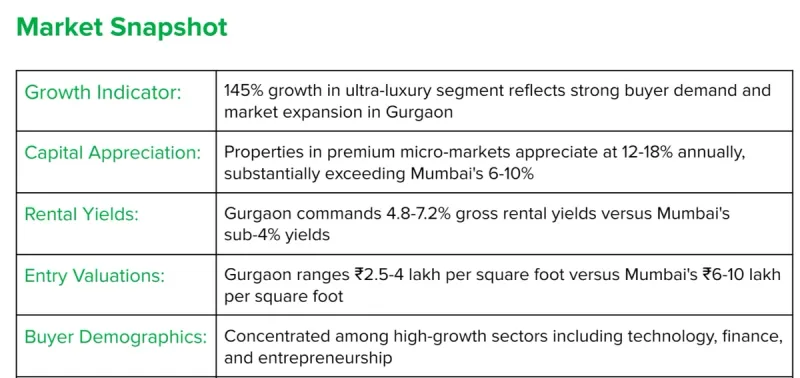
Recent market trends reinforce Gurgaon's superior investment positioning. The 145% growth in ultra-luxury properties reflects genuine market expansion rather than speculative activity. Transaction volumes in premium projects exceed historical levels, with consistent sales velocity indicating sustainable demand.
Buyer profile data reveals concentrated wealth among technology, finance, and entrepreneurship sectors—all high-growth industries with strong future earning potential. This demographic concentration supports long-term demand sustainability.
Infrastructure metrics show continuous improvement. Connectivity to Delhi Airport, expressway expansion, and commercial development create measurable enhancement to property accessibility and desirability.
New supply in ultra-luxury segments remains constrained. Major developers launch limited ₹10 crore+ projects, ensuring supply scarcity that supports appreciation. Mumbai's mature market, by contrast, features higher ongoing supply in established locations, constraining price appreciation.
These indicators collectively suggest Gurgaon's ultra-luxury segment remains in a favorable growth phase. Mumbai's ultra-luxury market operates in a mature, value-maintenance phase. For capital-seeking investors, this differentiation matters significantly.
Market Snapshot
Conclusion and Investment Takeaway
The data conclusively demonstrates why sophisticated investors increasingly favor Gurgaon's ultra-luxury properties over Mumbai's established premium market. The 145% growth in Gurgaon's ₹10 crore+ segment reflects genuine structural advantages: superior capital appreciation, competitive rental yields, infrastructure-driven value creation, concentrated high-growth buyer demographics, and meaningful international investment flows.
For HNWIs, NRIs, and portfolio investors evaluating where to deploy capital in India's premium residential sector, Gurgaon presents a compelling opportunity. The city offers superior risk-adjusted returns, meaningful appreciation potential, and sustainable rental income—a portfolio construction argument that established Mumbai properties no longer provide.
The optimal investment strategy often combines both markets: Mumbai properties for legacy status and wealth preservation, Gurgaon properties for growth and appreciation. However, for incremental capital seeking maximum returns, Gurgaon's luxury market clearly emerges as the superior choice.
Ready to explore ₹10 crore+ investment opportunities in Gurgaon's premium corridors? Connect with expert real estate advisors who specialize in ultra-luxury property investment strategies, detailed market analysis, and investor-specific portfolio construction. Your next premium real estate investment deserves professional guidance aligned with sophisticated investor expectations .
FREQUENTLY ASKED QUESTIONS
Q: Why has Gurgaon's ultra-luxury property segment grown 145% while Mumbai remained relatively stable?
A: Gurgaon's growth reflects several interconnected factors: concentrated wealth creation among high-income professionals in technology and finance sectors; continuous infrastructure improvements that systematically enhance valuations; limited ultra-luxury inventory creating supply-demand imbalances; and the city's evolution from corporate hub to lifestyle destination. Mumbai's mature market has already absorbed most wealth-seeking capital and infrastructure improvements, limiting growth catalysts. Gurgaon's growth phase offers appreciation potential that Mumbai's value-maintenance phase no longer provides.
Q: What's the realistic capital appreciation potential for ₹10 crore+ properties in Gurgaon's premium micro-markets?
A: Historical data from premium corridors like Golf Course Road and Golf Course Extension Road shows annual appreciation of 12-18%. Properties in emerging corridors like Dwarka Expressway and SPR demonstrate similar or higher appreciation as infrastructure improves. These returns substantially exceed Mumbai's ultra-luxury market, where appreciation typically ranges 6-10% annually. However, appreciation varies by specific micro-market, project quality, and holding period. Diversification across multiple premium locations reduces risk while capturing area-specific appreciation.
Q: How do rental yields compare between Gurgaon and Mumbai luxury properties?
A: Gurgaon premium residential properties command rental rates of ₹4-6 lakh monthly for ₹10 crore+ properties, translating to gross yields of 4.8-7.2% annually. Mumbai's ultra-luxury market typically yields below 4%, despite higher property valuations. This 1-3 percentage point yield advantage, compounded annually, significantly enhances returns for income-focused investors. Gurgaon's growing expatriate professional base creates sustained rental demand, supporting these yield levels
Q: Are Gurgaon luxury investments suitable for NRI investors compared to Mumbai?
A: Yes, strongly. Gurgaon offers several advantages for NRI investors: transparent regulatory framework for foreign investment; modern infrastructure and global-quality developments attractive to international residents; meaningful appreciation potential exceeding Mumbai's mature market; competitive rental yields for income diversification; and simpler property management compared to Mumbai's complex market dynamics. Additionally, Gurgaon's emerging global profile positions properties well for future repatriation discussions and international recognition. NRIs increasingly prefer Gurgaon over Mumbai for new wealth deployment.
Q: What's the minimum investment amount for entering Gurgaon's ultra-luxury property segment, and what returns can realistic investors expect?
A: Entry-level ultra-luxury properties in established micro-markets range from ₹10-15 crore in reputed developments. Premium properties in prime locations command ₹20-50+ crore. Realistic long-term return expectations (5-7 year holding periods) include: annual appreciation of 12-15%; rental yields of 5-6% for income-generating properties; and total returns (appreciation plus rental income) of 17-21% annually. These returns assume investment in quality projects in prime micro-markets during growth phases. Property selection, location timing, and builder reputation significantly influence actual returns achieved.
Q: How should investors decide between Mumbai and Gurgaon for ultra-luxury property investment?
A: Consider your investment objectives: appreciation-focused investors should strongly prefer Gurgaon's 12-18% annual appreciation over Mumbai's 6-10%; income-focused investors should favor Gurgaon's superior rental yields; wealth preservation investors might diversify between both markets; NRI investors have clear advantages with Gurgaon's transparent framework; first-time ultra-luxury buyers should favor Gurgaon's lower entry valuations and growth potential. Rather than viewing this as either-or decision, sophisticated investors often construct portfolios with both—Mumbai for establisd legacy status, Gurgaon for growth allocation. Your optimal
allocation depends on your specific investment timeline, return requirements, and portfolio construction objectives.