
Why Golf Course Road Rental Yields Defy National Trends
The Paradox of High Values and Elite Cash Flows
In the structural landscape of Indian real estate, conventional investment metrics dictate that hyper-inflated capital values inevitably cause an extreme compression of residential rental yields. Across major tier-1 metros—including parts of Mumbai’s South Mumbai enclave, Bengaluru’s central business districts, and South Delhi’s premium residential colonies—residential rental yields historically hover in a modest band of 2.0% to 2.8%.
However, Gurugram’s ultra-luxury baseline, specifically the premier strip known as Golf Course Road (Sectors 42 to 55), presents a unique market paradox.
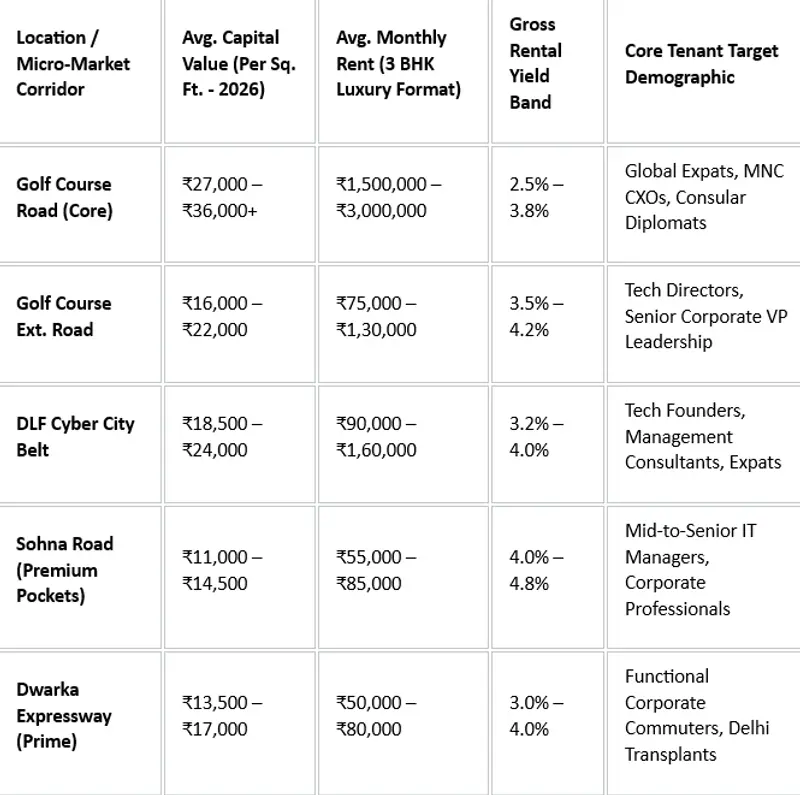
As we progress through 2026, average capital values on Golf Course Road have stabilized at impressive levels, frequently ranging between ₹27,000 and ₹36,000 per square foot for premium inventory, and climbing significantly higher for ultra-luxury residential landmarks. Yet, despite these steep entry barriers, the absolute rental income generated within this corridor remains exceptionally high.
While mid-segment markets chase raw percentage yields, Golf Course Road operates on a model known as the Scarcity Premium. It is a unique micro-market where limited premium inventory meets strong, non-price-sensitive demand from Fortune 500 executives, multinational corporations (MNCs), and global expatriates.
This analysis examines the operational, structural, and macroeconomic forces that allow Golf Course Road to maintain distinct cash-flow stability and continue defying standard national real estate trends.
The Macroeconomic Baseline: Gross vs. Net Yield Dynamics
To evaluate the investment landscape of Golf Course Road, institutional underwriters must separate absolute cash flow from percentage-based yields. In mid-segment corridors like New Gurgaon or Sohna Road, lower capital entry costs allow gross rental yields to reach 4.0% to 5.5%. On Golf Course Road, because capital appreciation has moved at a rapid pace over the last five years, gross residential yields sit within a specialized band of 2.5% to 3.8%.
However, looking only at the gross percentage misses the broader investment picture. The true value proposition of Golf Course Road lies in three core factors:
- Unmatched Absolute Cash Flow: A standard 3-BHK or 4-BHK residential unit routinely commands monthly rents ranging from ₹1.5 Lakh to over ₹3.5 Lakh. Ultra-luxury trophy assets in iconic developments easily cross ₹5 Lakh to ₹10 Lakh per month.
- Minimal Vacancy Risk: Due to the severe lack of ready, institutional-grade luxury supply along this specific corridor, quality units experience remarkably brief turnaround times between tenancies.
- Escalation Security: Standard lease agreements on Golf Course Road feature structured annual escalation clauses ranging from 5% to 8%, backed by reliable corporate and institutional tenants.
Data Profile: Comparative Performance Across Core Micro-Markets
The unique positioning of Golf Course Road becomes clear when evaluating its asset values, absolute monthly lease generation, and gross performance metrics alongside other primary luxury and premium investment zones in the National Capital Region (NCR) for 2026:
The Four Pillars of the Scarcity Premium
The ability of a single residential corridor to consistently command premium rents while insulating investors from volatility is driven by four structural pillars:
1. Absolute Spatial Exhaustion (Zero Elasticity of Supply)
The most significant factor supporting property values on Golf Course Road is the complete physical exhaustion of developable land parcels. The core stretch spanning Sectors 42 through 55 is fully built out.
Unlike newer, expanding peripheral roads where local planning authorities can continuously release fresh land sectors, Golf Course Road possesses a fixed supply. Any institutional investor or HNI seeking entry into a brand-new high-rise development must wait for rare, high-capital redevelopment plays. This structural supply ceiling ensures that as demand increases, the pressure reflects directly in rising asset valuations and rental pricing rather than expanding inventory.
2. The Integrated Corporate and Transit Ecosystem
Golf Course Road is engineered as a highly efficient "walk-to-work" and transit-insulated micro-market. The corridor features a dedicated 16-lane, signal-free underpass network that connects smoothly with National Highway 48 (NH-48), alongside the operational infrastructure of the Gurugram Rapid Metro system.
Crucially, the corridor terminates directly at DLF Cyber City—the primary corporate headquarters hub of Northern India, hosting over 250 Fortune 500 companies. For senior multinational corporate executives, managing directors, and global expatriates, the convenience of living within a 5-to-10 minute transit radius of their corporate offices eliminates the regional gridlock common across the broader NCR.
3. Expatriate and Institutional Leasing Infrastructure
The tenant profile on Golf Course Road represents a highly specialized segment of the rental market. The concentration of premium residential communities—headlined by iconic developments like DLF’s The Aralias, The Magnolias, and The Camellias—has established a dedicated local ecosystem catering to global corporate standards.
Leases within these landmark developments are frequently secured through direct corporate invoicing from global entities, technology conglomerates, and foreign embassies. These institutional tenants prioritize high-end security parameters, international schools, advanced air filtration systems, and full-service club operations. Because these lease expenses are typically covered by corporate relocation packages rather than individual income, the rental market demonstrates strong resilience during broader economic shifts.
4. Gated Club Communities as a Closed Network
A key element supporting the rental premium on Golf Course Road is the lifestyle ecosystem built directly into its landmark projects. Developments along this corridor operate less like traditional apartment complexes and more like ultra-exclusive, private country clubs.
With massive internal clubhouses, private internal restaurants managed by award-winning chefs, professional sports installations, and direct access to championship golf courses, these developments function as self-contained micro-enclaves. This lifestyle framework creates strong resident retention, minimizing tenant turnover and protecting landlords from the long vacancy periods that can impact standard residential properties.
Risk Mitigation for Global Landlords: Optimizing Net Cash Flow
For institutional asset managers and individual landlords operating within this high-value corridor, maximizing real returns requires managing specific cost factors that can impact net rental efficiency:
- Managing High Premium Maintenance Drags: Ultra-luxury societies on Golf Course Road feature advanced infrastructural footprints, resulting in substantial monthly maintenance fees that regularly range from ₹6 to well over ₹12 per square foot on super built-up areas. Landlords must ensure lease structures clearly assign these recurring maintenance overheads to the incoming tenant or adjust the base rental price accordingly to safeguard net returns.
- Executing Proactive Refurbishment Cycles: The premium corporate and expat tenant profile expects flawless interior specifications. To command top-of-market rental rates and secure swift lease renewals, properties must undergo regular updates. This includes maintaining advanced home automation systems, premium modular kitchen setups, and modern HVAC configurations between tenant transitions.
- Navigating the Structural Product Premium: There is a distinct pricing and rental divergence between legacy high-rises built in the early 2010s and the modern, high-specification towers delivered in recent years. Investors looking for assets must evaluate whether an older resale unit can justify the capital expenditure needed for structural interior remodeling, or if paying a premium for newer construction offers a more efficient path to secure immediate corporate tenant placement.
The Ultimate Wealth Preservation Engine
The performance of Golf Course Road residential rental yields confirms its position as India’s premier luxury real estate corridor. While investors focused solely on maximizing short-term yield percentages look toward expanding peripheral sectors, Golf Course Road serves a fundamentally different portfolio purpose.
Backed by absolute spatial limits, an irreplaceable corporate ecosystem, and institutional-grade tenant stability, it operates as a resilient wealth-preservation engine. For global funds, family offices, and discerning investors, the premium paid to enter this market buys long-term capital protection, reliable cash flow stability, and an asset class that consistently outpaces national real estate performance benchmarks.
FAQ Section
1. Why do gross rental yield percentages on Golf Course Road appear lower than mid-segment sectors despite commanding India's highest rents?
Rental yield is a direct mathematical ratio of annual rental income to the property's total capital valuation. Because property capital rates on Golf Course Road have appreciated significantly over the last few years (now averaging ₹27,000 to ₹36,000+ per sq. ft.), the total asset valuation base has grown faster than rental pricing. Consequently, while the absolute monthly rent is exceptionally high, the gross percentage yield compresses to a stable 2.5% to 3.8% band.
2. Who is the primary target tenant demographic driving the luxury rental market on Golf Course Road?
The rental landscape is heavily anchored by global expatriates, consular diplomats, foreign trade delegates, and CXO-level corporate leaders managing prominent multinational firms located in the adjacent DLF Cyber City and Horizon Center business complexes. These premium profiles look for advanced security, high-end lifestyle amenities, and proximity to international schools, making them willing to pay a premium for properties that meet their standards.
3. How do recurring society maintenance charges affect net rental yields for landlords along this corridor?
Premium gated communities on Golf Course Road offer extensive operational infrastructures, resulting in monthly maintenance expenses ranging from ₹6 to ₹12+ per square foot. On a large-format luxury property, these charges can represent a meaningful monthly out-of-pocket cost. If the landlord absorbs these fees rather than structure the lease so the tenant covers them, the net rental yield typically scales down to a tighter 2.0% to 3.0% range.
4. Is there a visible difference in rental demand between older established legacy towers and newly launched projects on Golf Course Road?
Yes, there is a clear product premium. Modern corporate and expatriate tenants consistently show a strong preference for contemporary floor configurations, newer construction styles, and updated home automation setups. While legacy towers continue to benefit from excellent neighborhood locations, landlords owning older inventory often need to invest in interior refurbishments to maintain top-tier rental performance and minimize vacancy times.
5. What long-term factors protect Golf Course Road rental assets from broader market downturns?
The primary protection is absolute supply limitation. Because the core geographic sectors of Golf Course Road are completely developed, there is no risk of localized oversupply creating downward pressure on prices. Additionally, because many leases are held directly through long-term corporate agreements backed by international firms rather than individual short-term renters, the cash flow model remains highly insulated from temporary economic shifts.