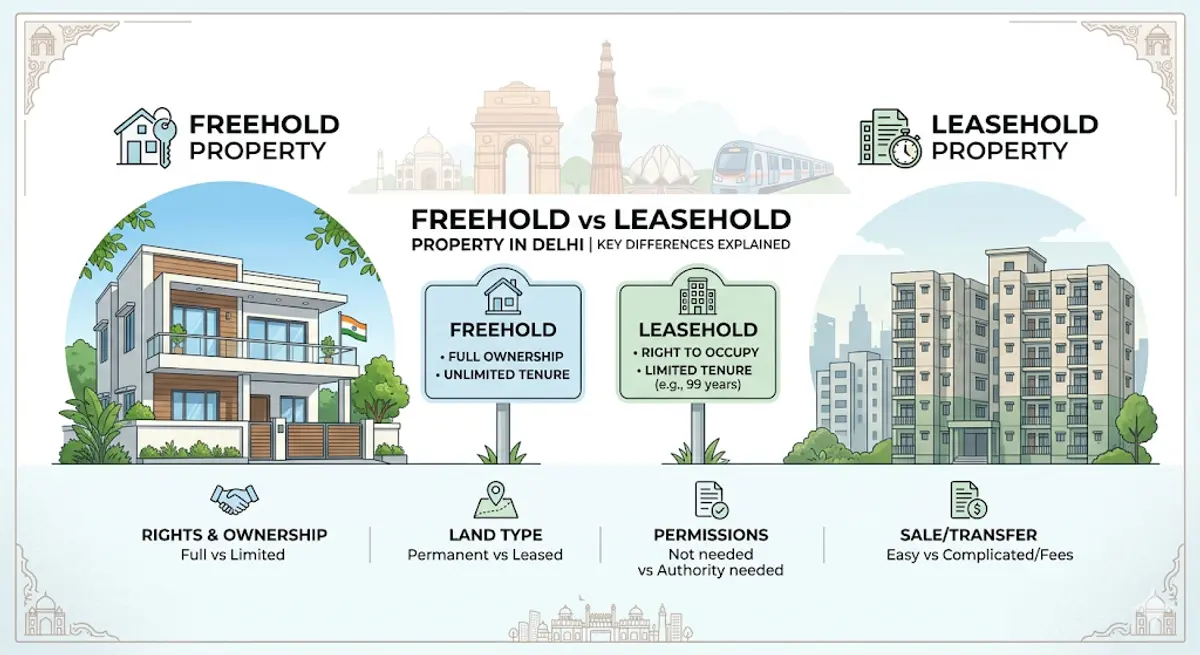
Freehold vs Leasehold Property in Delhi | Key Differences Explained
Freehold vs Leasehold Property in Delhi | Key Differences Explained
The Freehold vs Leasehold Distinction in Delhi
One of the most critical and often misunderstood aspects of buying property in Delhi is the distinction between freehold and leasehold ownership. Unlike most other Indian cities where most private property is freehold, Delhi has a significant proportion of leasehold properties — primarily in DDA-developed areas and Cantonment zones.
Freehold Property — Full Ownership
In a freehold property, the buyer owns both the structure and the land in perpetuity. This is the most comprehensive and legally straightforward form of property ownership. Freehold properties in Delhi are concentrated in pre-planned south Delhi colonies (Defence Colony, Friends Colony), West Delhi private developments, and newer private builder projects.
Freehold properties command 10–25% price premiums over comparable leasehold properties and are preferred by banks for home loan financing.
Leasehold Property — Time-Bound Land Rights
Leasehold properties in Delhi are typically on 99-year leases from DDA, NDMC (New Delhi Municipal Council), or the Ministry of Defence (for Cantonment properties). The leaseholder owns the structure but the land remains government-owned.
At lease expiry (after 99 years), the lease can typically be renewed, but the process involves additional fees and government involvement. In practice, leasehold properties rarely face actual expiry issues, but the theoretical risk affects resale values.
Impact on Home Loans
Several banks and NBFCs are cautious about lending against leasehold properties, particularly those with shorter residual lease terms. Most lenders require a minimum residual lease of 25–30 years beyond the loan tenor.
Freehold properties have no such limitations and are universally accepted as collateral by all lenders. This higher financing flexibility adds to the freehold premium.
Converting Leasehold to Freehold
DDA has periodically announced leasehold-to-freehold conversion schemes for residential properties in Delhi. The conversion cost is based on the current circle rate and can be significant — sometimes 5–15% of the property value. However, conversion permanently enhances the property's marketability and value.
If you own a leasehold property in Delhi, tracking DDA's conversion scheme announcements and applying promptly is advisable.
Conclusion
For Delhi property buyers, freehold is unambiguously preferable — it offers cleaner title, better financing options, and higher resale values. If considering a leasehold property for its lower price or preferred location, ensure thorough legal due diligence on the lease terms, residual lease period, and conversion possibilities.