Circle Rates vs Market Price Gurgaon: Managing the 60% Valuation Gap
The Valuation Disconnect in Gurugram’s Premium Corridors
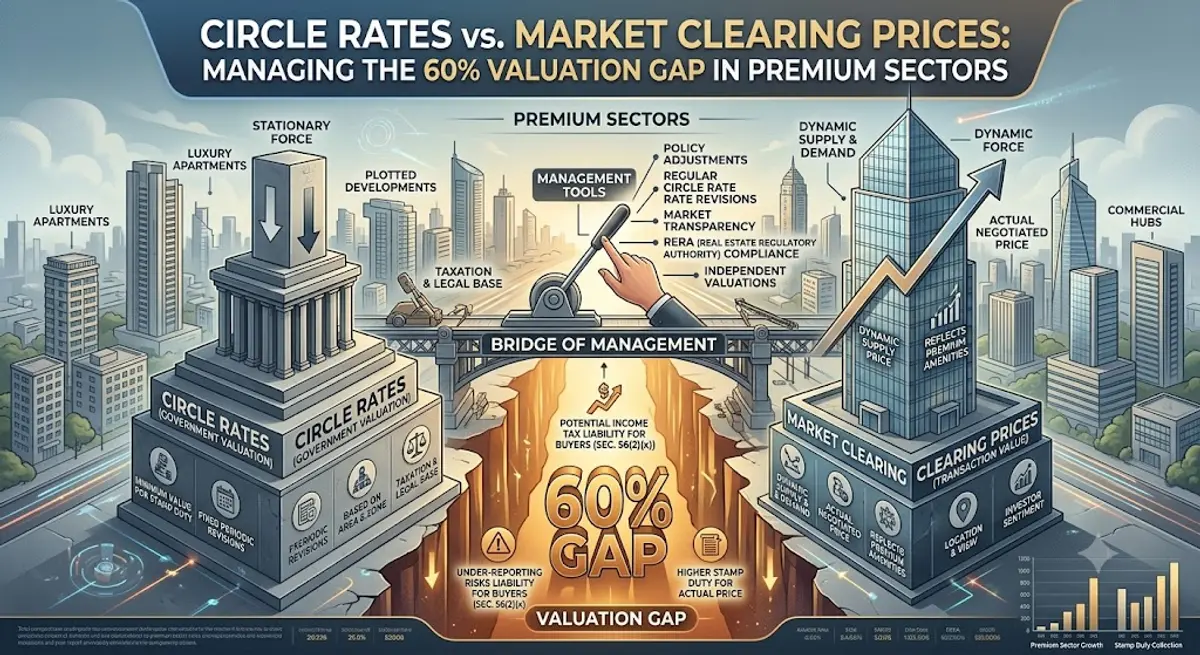
In Gurugram’s ultra-luxury and premium real estate corridors—most notably along the Golf Course Road, Golf Course Extension, and select pockets of Southern Peripheral Road (SPR)—a profound economic anomaly has solidified. The circle rates vs market price Gurgaon disparity has widened to as much as 60% in specific luxury clusters.
While the administrative circle rate acts as the government’s baseline floor price for registry and stamp duty collection, the market clearing price—driven by institutional demand, global NRI capital, and scarcity value—has broken free from these artificial baselines. Navigating this massive valuation gap requires deep mastery of tax compliance, asset valuation metrics, and strategic capital structuring.
Deconstructing the 60% Gap: Why Administrative Rates Lag Behind Market Reality
The fundamental reason behind the immense divergence between official collector values and actual market clearing transactions is the velocity of demand. Gurugram's premium luxury segment has experienced unprecedented capital appreciation over the last 36 months, driven by structural shifts toward high-end condominiums and gated ecosystems. Administrative revisions, typically managed by the district administration on an annual or semi-annual basis, are inherently reactive. They rely on historical registry filings which frequently underrepresent real-time transactional velocity.
Furthermore, premium developments by tier-1 developers command a "brand and lifestyle premium" that municipal valuations cannot easily quantify. Features such as private elevator lift lobbies, dual-kitchen designs, advanced air filtration systems, and exclusive concierge clubs push the market clearing price upward. Meanwhile, the circle rate treats the underlying asset as generic square footage within a specific sector plot, ignoring the architectural and brand value that modern high-net-worth individuals (HNWIs) prioritize.
Tax Implications Under Section 43CA and 56(2)(x): Navigating the Legal Minefield
For corporate developers and luxury buyers, a massive gap between the circle rate and the transaction value creates unique structural challenges under the Indian Income Tax Act. Historically, the primary concern was transactions occurring below the circle rate, which triggers harsh tax penalties under Section 43CA (for developers) and Section 56(2)(x) (for buyers). However, when the market price is vastly higher than the circle rate, an entirely different set of operational hurdles emerges:
A. The Capital Gains Compounding Effect
When an investor acquires a premium asset at a market clearing price of ₹25,000 per sq. ft. while the baseline circle rate sits at ₹10,000 per sq. ft., the transaction must be fully recorded at the higher market value to ensure absolute transparency. The future capital gains tax exposure must be calibrated against this high acquisition cost base, requiring immaculate transaction records to prevent future audit friction with the Income Tax Department.
B. Banking and Construction Loan LTV Limitations
Many banking institutions use conservative valuation models that look closely at official circle rates when assessing maximum Loan-to-Value (LTV) ratios. When the valuation gap reaches 60%, securing optimal institutional leverage becomes complex. Lenders may refuse to finance the full market premium, forcing buyers to deploy significantly higher components of equity capital to close premium acquisitions.
Sector-by-Sector Analytics: Mapping the Valuation Disparities
The valuation gap is not uniform across the city. It concentrates heavily within specialized high-barrier micro-markets. Understanding these specific numbers is essential for precise property tax calculation Gurugram projections and capital allocation.
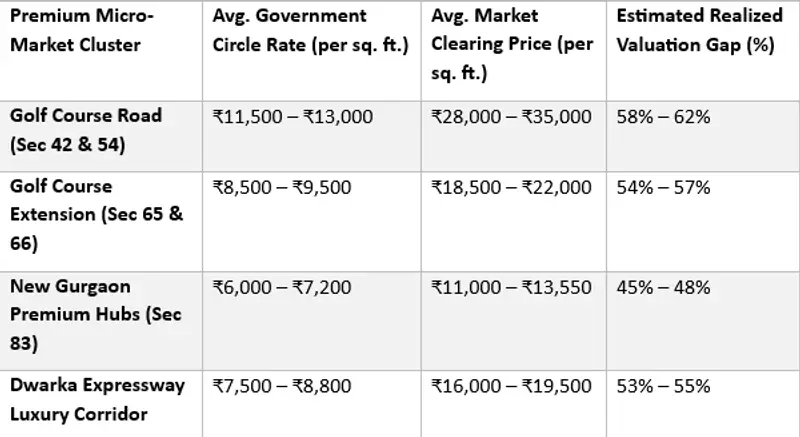
This data highlights why general market assessments fail in Gurugram. An investor looking at official collector records would completely misjudge the actual liquidity requirements and capital entry barriers that define the modern Gurgaon premium sector property rates.
Strategic Financial Mitigation for HNWIs and Corporate Buyers
Managing a wide valuation gap requires institutional-grade wealth structuring and proactive tax planning. Leaving these spreads unmanaged can result in long-term capital lockups and costly regulatory audits.
A. Deploying Independent RICS-Certified Valuations
Before finalizing any high-value transaction where the market clearing price exceeds the circle rate by more than 40%, buyers should commission an independent valuation report from a Royal Institution of Chartered Surveyors (RICS) certified appraiser. This document serves as vital legal backing during income tax assessments, proving that the transaction premium reflects genuine market demand rather than arbitrary inflation.
B. Adjusting Component-Level Accounting
Corporate buyers can optimize their balance sheet allocations by cleanly separating the pure undivided share of land (UDS) from the super-structural and interior fit-out value components. By treating premium automation systems, interior design, and multi-car parking rights as distinct operational line items, corporate entities can build a highly accurate asset depreciation schedule while maintaining full compliance.
Frequently Asked Questions (FAQ)
Q1: Does a higher market price relative to the circle rate increase my stamp duty liability in Gurgaon?
No. In Haryana, stamp duty is calculated on the higher of the two values: the actual agreed transaction value stated in the sale deed or the government circle rate. Because your market clearing price is higher than the circle rate, your stamp duty will be assessed directly on the total transaction value.
Q2: How does the circle rate gap affect property tax calculation Gurugram?
Property tax in Gurugram is calculated by the Municipal Corporation of Gurugram (MCG) based on parameters like built-up area, category of use, and location zones, rather than directly using the market transaction value. A high market premium will not automatically spike your annual municipal property tax bill.
Q3: Can banks lower my loan approval amount because of a 60% valuation gap?
Yes. Many conservative banking institutions limit their risk exposure by aligning their internal valuations closer to local government baselines or strict construction costs. If the market price includes a high brand premium, you may face lower Loan-to-Value (LTV) ratios, requiring you to bring more upfront equity capital to close the purchase.
Q4: What is the safe harbor premium allowed under Section 43CA of the Income Tax Act?
The current safe harbor tolerance band allows for a variance of up to 10% between the actual consideration received and the official circle rate value. However, this safe harbor primarily protects transactions where the market value drops slightly below the circle rate, not high-premium acquisitions.
Q5: Is the valuation gap expected to narrow in premium Gurgaon sectors over 2026?
The gap will likely remain wide in premium sectors because tier-1 luxury inventory continues to see fast-paced capital appreciation. While the district administration frequently increases circle rates during annual reviews, their adjustments are conservative and rarely catch up to real-time market spikes on Golf Course Road.
Q6: How should corporate buyers document the market premium to satisfy income tax authorities?
Corporate buyers should maintain a robust transaction trail. This includes preserving competitive market bidding logs, current developer price lists, third-party RICS appraisal reports, and documented bank valuations. These files demonstrate that the price paid matches true arms-length market conditions.