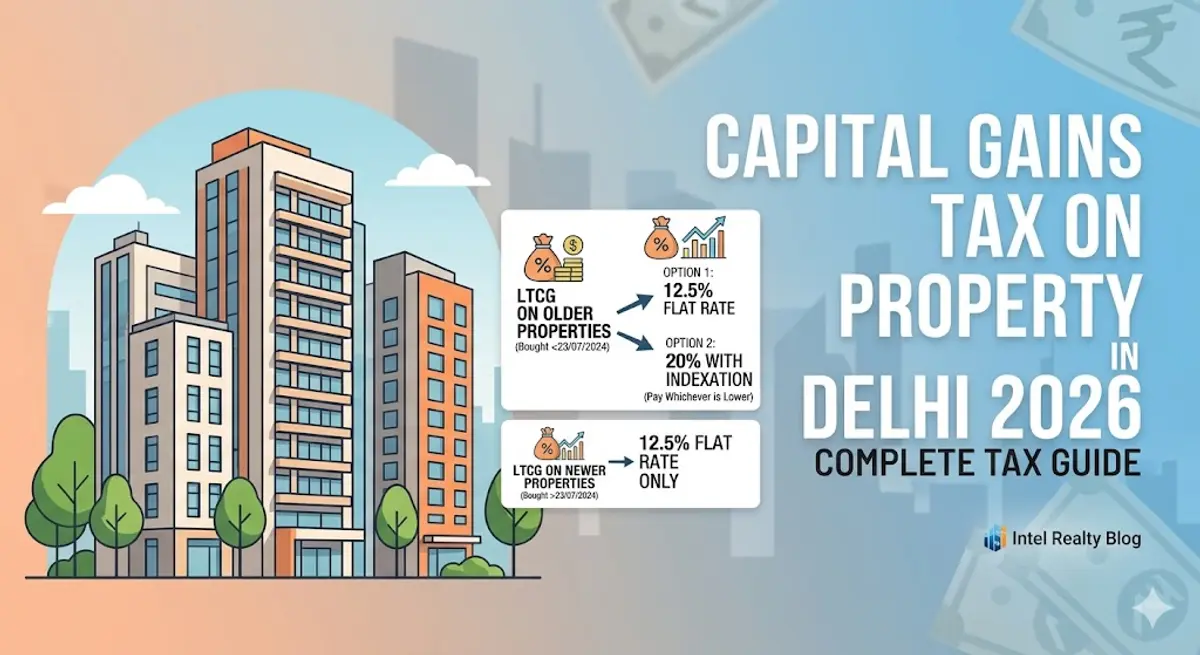
Capital Gains Tax on Property in Delhi 2026 | Complete Tax Guide
Capital Gains Tax on Property in Delhi 2026 | Complete Tax Guide
Capital Gains — The Tax Most Sellers Overlook
When selling a property in Delhi, most sellers focus on the transaction price and forget to plan for capital gains tax until it is too late for effective mitigation. With high-value Delhi properties, the tax liability can run into tens of lakhs — making advance planning essential.
Short-Term vs Long-Term Capital Gains
Properties held for less than 24 months generate Short-Term Capital Gains (STCG), taxed at your applicable income tax slab rate. For high-income sellers, this can be 30% + surcharge + cess — an enormous tax burden.
Properties held for 24+ months generate Long-Term Capital Gains (LTCG), taxed at 20% with the benefit of Cost Inflation Index (CII) indexation, which adjusts your original purchase price for inflation, significantly reducing the taxable gain.
How Indexation Works
Indexation adjusts your purchase price using the Cost Inflation Index published by the income tax department annually. Example: a property purchased in 2010 for ₹50 lakhs sold in 2025 for ₹1.5 crore. The indexed purchase price (using CII) might be ₹90 lakhs, reducing the LTCG to ₹60 lakhs instead of ₹1 crore — saving approximately ₹8 lakhs in tax.
Section 54 Exemption
Under Section 54, LTCG from sale of a residential house is fully exempt if you reinvest the entire gains in another residential house within 2 years of sale (or 1 year before sale). The new property must be purchased and not sold within 3 years.
If you cannot immediately reinvest, deposit the gains in a Capital Gains Account Scheme (CGAS) before the return filing deadline to preserve the exemption.
Section 54EC — Bond Investment
Alternatively, LTCG of up to ₹50 lakhs can be invested in NHAI or REC bonds within 6 months of property sale to claim exemption under Section 54EC. These bonds have a 5-year lock-in period and currently offer interest rates of 5.25–5.75%.
Conclusion
Capital gains tax planning should begin as soon as you decide to sell your Delhi property — not after the sale. Consult a CA familiar with property transactions to calculate your exact liability and identify the most appropriate exemption strategy based on your specific circumstances.