
BRANDED RESIDENCES IN GURGAON: ARE THEY WORTH THE INVESTMENT PREMIUM?
Introduction
Gurgaon's luxury market increasingly features hotel-branded residences—Marriott Residences, Hilton Honors Residences, and independent luxury brands launching premium residential collections. Branded properties command 20-35% price premiums over comparable unbranded luxury apartments, justified by lifestyle amenities, hotel services, and brand prestige. Investors face critical evaluation: do premium prices deliver proportionate returns or overpay for branding?
This analysis compares branded and unbranded luxury properties, examining return profiles, occupancy characteristics, and investment viability.
Why Branded Residences Command Premium Pricing
Lifestyle Amenity Integration
Branded residences incorporate hotel-grade amenities—spa facilities, concierge services, fine dining restaurants, premium gyms, and entertainment venues. Comprehensive amenity packages create lifestyle experiences exceeding standard luxury developments. Premium specifications justify elevated pricing positioning.
Hotel-grade amenities differentiate branded properties from traditional luxury apartments.
Brand Prestige and Market Positioning
Established hospitality brands (Marriott, Hilton) transfer luxury positioning and brand equity to residential offerings. Brand prestige attracts trophy buyers valuing luxury designation and lifestyle affiliation. Brand association commands pricing premiums reflecting intangible brand value.
Brand prestige creates psychological premium positioning among luxury buyers.
Service Integration and Concierge Support
Branded residences offer hotel-level concierge services—housekeeping, room service, valet, and guest services. Service integration provides lifestyle convenience traditionally unavailable in residential environments. Premium services justify service-level pricing.
Hotel service integration differentiates branded residential experience.
International Guest Access and Rental Potential
Hotel affiliation enables residential units marketed to hotel guests, corporate housing programs, and short-term rental platforms. Branded properties access hotel distribution networks generating rental demand alternatives. Multiple revenue streams enhance yield potential.
Multi-channel distribution supports higher occupancy and rental rates.
Key Branded Vs Unbranded Comparison
Pricing Differential Analysis
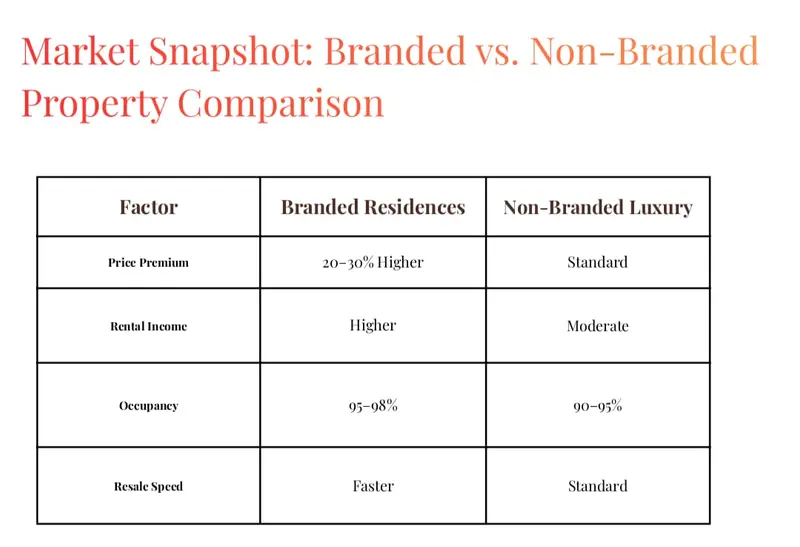
Branded residences typically price 20-35% above comparable unbranded luxury apartments. ₹5 crore unbranded 3-4 BHK apartment compares to ₹6.5-6.75 crore branded equivalent. Premium pricing reflects lifestyle, amenities, and service-level positioning.
Branded premium: ₹1.5-1.75 crore ($180,000-210,000 USD) on ₹5 crore property.
Rental Yield Comparison
Branded properties generate 2.5-3.5% yields through higher rental rates (₹1.80-2.40 lakh monthly) versus unbranded 2.0-2.8% yields (₹1.40-1.80 lakh monthly). Premium rental positioning captures brand positioning value. However, premium pricing often offsets yield advantage.
Branded yield premium: 0.3-0.7% annual advantage through higher rents.
Occupancy and Tenant Quality
Branded properties attract premium tenant bases—international executives, luxury-seeking professionals, and corporate housing programs. 95%+ occupancy rates exceed unbranded average 90-93%. Premium occupancy reduces vacancy costs. However, unbranded properties achieve comparable occupancy through professional management.
Branded occupancy premium: 2-5% higher consistency reflecting premium positioning.
Appreciation Characteristics
Branded property appreciation (7-10% annually) slightly exceeds unbranded equivalents (6-8% annually). Brand recognition provides valuation support during market cycles. However, branding impact decreases post-purchase as property age increases and brand novelty diminishes.
Branded appreciation premium: 1-2% annually—marginal advantage eroding over time.
Resale Liquidity
Branded properties demonstrate slightly faster sale timelines (60-90 days) versus unbranded luxury apartments (90-120 days). Brand recognition facilitates buyer identification. However, premium pricing may offset liquidity advantage through smaller buyer pools.
Branded liquidity premium: 15-30 days faster sale timeline potentially.
Financial Return Comparison: Branded vs Unbranded
Branded Property Scenario
Purchase: ₹6.5 crore branded 3-4 BHK (20% premium over unbranded ₹5.4 crore equivalent). Rental deployment: ₹2.2 lakh monthly (3.4% yield). Appreciation: 8.5% annually. 5-year total return: ₹1.1 crore appreciation plus ₹1.32 crore rental income = ₹2.42 crore total (37.2% gain).
Unbranded Property Scenario
Purchase: ₹5.4 crore unbranded 3-4 BHK (20% discount vs. branded). Rental deployment: ₹1.55 lakh monthly (2.8% yield). Appreciation: 7.5% annually. 5-year total return: ₹0.81 crore appreciation plus ₹0.93 crore rental income = ₹1.74 crore total (32.2% gain).
Return Differential
Branded: 37.2% total return vs. Unbranded: 32.2% total return. Branded premium generates 5% higher absolute return on higher capital base. However, returns-on-capital diverge less dramatically—branded 5.7% annualized vs. unbranded 6.4% annualized. Premium pricing moderates return advantage.
Top Branded Residence Locations in Gurgaon
Golf Course Road Branded Properties
Hotel-branded residences positioned in Golf Course Road premium corridor. Properties valued ₹7-10 crore with established luxury brand prestige. Premium tenant bases from nearby corporate centers. Strong international appeal justifies branded positioning. However, Golf Course Road already commands premium unbranded pricing—incremental brand premium less significant.
Sector 46 and Contiguous
Mid-range branded residences in Sector 46 corridor. Properties valued ₹5-7 crore capturing premium positioning at accessible pricing. Professional tenant bases from corporate proximity. Balanced branding value through lifestyle upgrade at moderate premium pricing.
Emerging Corridor Branded Launch
Select branded launches in Sector 109-110 and emerging zones. Properties valued ₹4-5.5 crore with development-stage pricing. Brand positioning differentiates emerging corridor offerings from unbranded competition. Emerging zone branding captures market-discovery premium alongside development appreciation.
Market Snapshot 2026
Investment Viability Analysis
When Branded Properties Make Sense
Branded properties suit investors prioritizing lifestyle, prestige, and premium tenant targeting. International investors seeking trophy properties and brand affiliation justify branded positioning. HNI buyers prioritizing brand association and lifestyle experience support branded investment rationale. Branded positioning provides psychological benefits beyond financial returns.
Branded properties suit prestige-oriented investors accepting premium pricing for lifestyle.
When Unbranded Alternatives Dominate
Financial-return-focused investors benefit from unbranded properties offering similar risk-adjusted returns at lower capital deployment. Professional property management enables comparable occupancy and rental collections without brand premium. Unbranded strategy optimizes returns-on-capital through lower entry pricing.
Unbranded properties deliver superior financial returns for cost-conscious investors.
Hybrid Strategy Consideration
Portfolio combining branded prestige properties with unbranded return-optimized holdings balances lifestyle and financial outcomes. Branded properties provide portfolio anchor and prestige positioning; unbranded holdings maximize return efficiency. Hybrid approach captures brand benefits while optimizing overall portfolio returns.
Diversified strategy balances lifestyle positioning with financial efficiency.
Conclusion
Branded residences command 15-35% premiums over comparable unbranded luxury properties, generating 35-40% 5-year total returns versus 30-36% unbranded equivalents. Marginal return advantages (5% differential) don't proportionately justify 20-35% purchase premium—annualized returns approximate 6-8% for both strategies.
Branded property investment viability depends on investor priorities. Prestige, brand affiliation, and lifestyle amenities justify premium for trophy buyers. Cost-conscious return-optimization favors unbranded alternatives. Both strategies deliver comparable risk-adjusted returns—choice reflects investor philosophy rather than financial necessity.
Evaluate branded positioning based on priorities. Connect with advisors who analyze branded versus unbranded investment viability, helping align property selection with your wealth creation objectives and lifestyle preferences.
FREQUENTLY ASKED QUESTIONS
Q: Do branded residences deliver returns justifying 20-35% premium pricing?
A: Branded properties generate 35-40% 5-year total returns versus unbranded's 30-36%—only 5% absolute advantage. Annualized returns approximate 6-8% both strategies. Premium pricing doesn't proportionately translate to superior returns. Branded viability depends on lifestyle value prioritization rather than financial superiority.
Q: Which branded residences perform best in Gurgaon?
A: Golf Course Road branded properties maintain premium positioning with established brand recognition. Sector 46 mid-range branded residences offer accessible luxury with professional tenant bases. Emerging corridor branded launches capture market-discovery premiums. Branded performance depends on corridor positioning and brand portfolio maturity.
Q: Can unbranded properties achieve comparable occupancy to branded?
A: Yes. Professional property management enables 90-95% unbranded occupancy rates approaching branded consistency. Tenant quality depends on location fundamentals and management excellence rather than branding alone. Well-managed unbranded properties achieve branded-level occupancy through operational excellence.
Q: Should NRI investors prioritize branded or unbranded positioning?
A: NRI investors prioritizing income consistency benefit from branded premium occupancy rates (93-98%) and service reliability. Cost-conscious NRI investors maximize returns through unbranded alternatives offering comparable fundamentals. Decision reflects individual return priorities versus lifestyle preferences.
Q: When does branded premium investment make strategic sense?
A: Branded investment suits trophy buyers prioritizing prestige and brand affiliation, international investors seeking lifestyle premium, and HNI families valuing brand experience. Return-focused investors benefit from unbranded alternatives. Decision reflects investor values rather than financial necessity.
Q: How long before branded premium investment recovery occurs?
A: Branded premium typically recovers within 3-5 years through excess rental rates and appreciation advantage. Early exit before recovery timeline may result in below-market pricing. Extended holding periods enable branded premium recovery through compounded excess returns over time.